
Reading. The think tank BIPART has published the first full count of meetings between the heads of Belarus’s regional executive committees and Russian governors. It covers January 2018 to July 2026. Because it prints every meeting in an appendix, we could rebuild its figures. The headline numbers hold to the unit, the profile of the Hrodna region does not, and the growth the study describes peaked in 2025. Since 2023, most of these meetings had an official under Western sanctions on at least one side. What we do not know is what any meeting delivered in trade: neither the study nor the regions publish it.
What the study counted
The study, Beyond Moscow and Minsk: Cooperation between Belarusian and Russian Regions, is published in English and in Russian. It treats the regions as their own level of Belarus–Russia relations. It counts 168 cooperation agreements between Belarusian regional bodies and Russian regions, plus 83 between Russian regions and the Belarusian government. It then counts 176 two-way meetings between regional chairmen and Russian governors, and 87 meetings between Russian governors and Lukashenko.
The agreement count has an outside check. At the Forum of Regions in June 2026, the Russian senator Andrei Shevchenko said that 250 agreements between Belarusian authorities and Russian regions are in force. The study’s two numbers add up to 251, close enough to suggest that both counts cover the same documents.
Its most useful finding is about distance. Brest meets Irkutsk and Mahiliou meets Khabarovsk, though these regions are thousands of kilometres apart. The study’s explanation is administrative. Minsk assigns each Russian region to a Belarusian official, who then has to keep the relationship going. Regular meetings with a distant region are therefore often a duty that comes with the post.
We copied all 176 rows of the appendix into a table. The totals by Belarusian region, by year, by format and by outcome match the study’s charts exactly. That is rare in this field, and it makes the next two findings possible.
A meeting with a distant Russian region is often a duty that comes with the post.
One profile that does not match the list
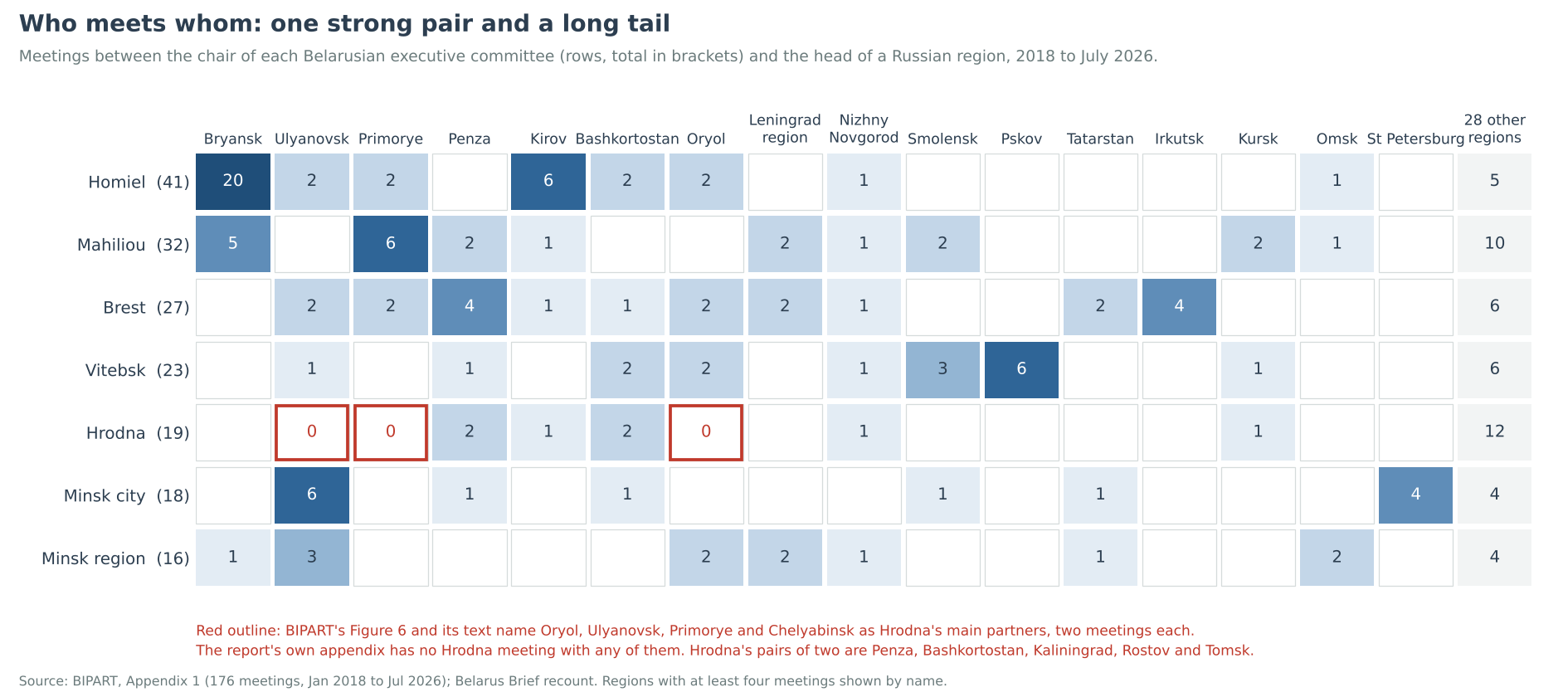
The study’s Figure 6 names Hrodna’s main Russian partners as Oryol, Ulyanovsk, Chelyabinsk, Primorye and Bashkortostan, with two meetings each. The text explains each one: an agreement with Oryol since 2011, Chelyabinsk metal for Hrodna factories. But the appendix has no Hrodna meeting with Oryol, Ulyanovsk, Chelyabinsk or Primorye. The same five regions do appear, with two meetings each, in the list for Homiel. The Hrodna panel looks like a copy of the Homiel one, and the English edition repeats the same list.
Hrodna’s real pairs of two are Penza, Bashkortostan, Kaliningrad, Rostov and Tomsk. The study’s conclusion still stands: Hrodna spreads its contacts thinly. Most of its explanation concerns regions that Hrodna’s chairmen did not meet.
The chart also shows how unusual Homiel is. Bryansk accounts for 20 of its 41 meetings. No other Belarusian region has a partner like that. Geography explains much of it. The Bryansk region is the only Russian region that borders the Homiel region. Its capital is also the nearest Russian regional centre to Homiel, about 270 km by road, against about 310 km to Smolensk and 390 km to Oryol.
Vitebsk and Mahiliou each border two Russian regions, and neither has a partner of Bryansk’s weight. The study groups Mahiliou with Homiel as a region with a stable core. Yet Mahiliou spread its 32 meetings across 16 Russian regions, about as thinly as Brest and Hrodna.
A curve that turned
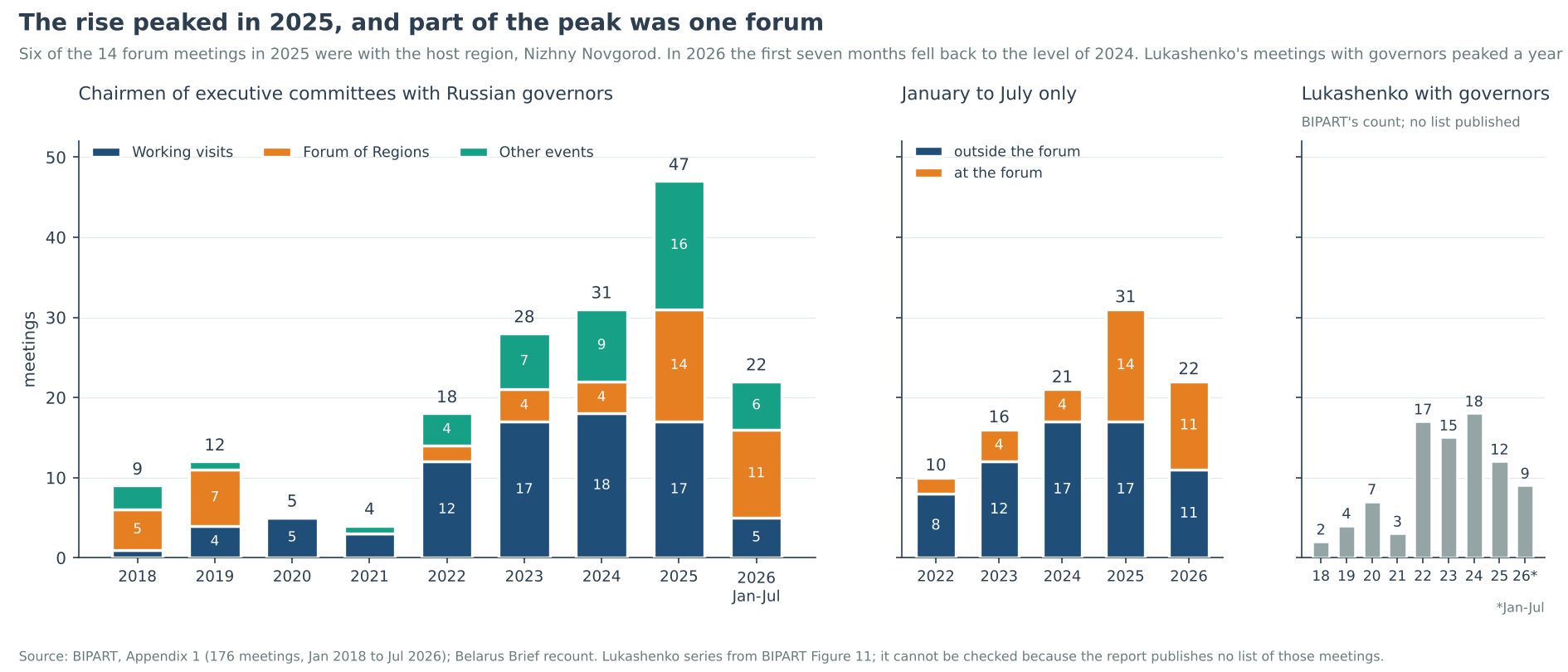
The study’s main chart shows meetings rising from four in 2021 to 47 in 2025. Two details in its own list change that picture.
The first is the Forum of Regions. In 2025 it took place in Nizhny Novgorod, and 14 of the year’s 47 meetings happened there. Six of the 14 were with the host region. Nizhny Novgorod appears in the list six times in total, all in that one June. The 2023 forum in Ufa shows the same effect: three of its four meetings were with Bashkortostan.
The second is 2026. The study shows 22 meetings for January to July next to full years. Compared month for month, the first seven months of 2025 had 31. Outside the forum, the count fell from 17 to 11, below 2024. The study’s own count of Lukashenko’s meetings with governors fell earlier: 18 in 2024, 12 in 2025, nine in the first seven months of 2026.
There are other ways to read this. Readouts from the summer of 2026 may still surface, since the list was closed in July. And one weaker year after four strong ones may turn out to be noise. Our count of August to December, due in January, will show which reading holds.
Compared month for month, 2026 is running below 2025.
The study explains the rise after 2022 mainly by the war and the sanctions that followed. Its data cannot separate that from other causes. Meetings were climbing back from a pandemic low. The integration plan of November 2021, with its 28 union programmes, was already in place before the invasion. And Lukashenko’s own meetings with governors rose in 2020, from four to seven. That was the year of the disputed election, after which Minsk leaned harder on Moscow.
Who sat at the table
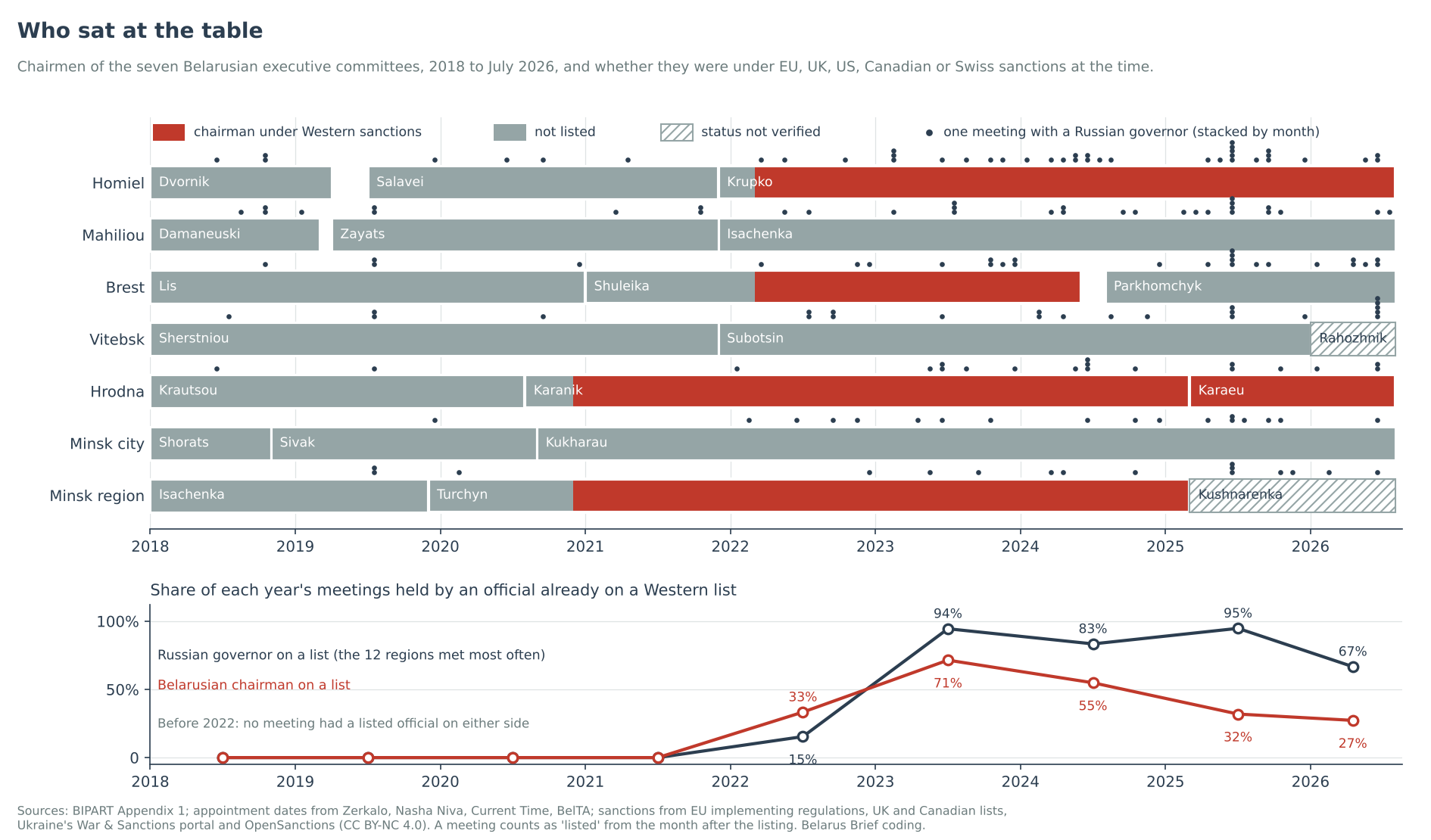
In Where They Went we followed the security officials the EU listed in 2020. One of them was the interior minister, Yury Karaeu, listed by the EU on 2 October 2020. Since March 2025 he has chaired the Hrodna executive committee. The BIPART list records six meetings for him with Russian governors. At least three of his counterparts were on a Western list at the time: Gleb Nikitin of Nizhny Novgorod, Oleg Melnichenko of Penza and Alexander Sokolov of Kirov. With Melnichenko he signed documents at the 2025 forum.
He is not an exception. Four other Belarusian chairmen were on a Western list while they held the post. Uladzimir Karanik of Hrodna and Aliaksandr Turchyn of the Minsk region were listed by the EU in December 2020. Yury Shuleika of Brest and Ivan Krupko of Homiel were listed by the UK in March 2022. Krupko alone held 34 of the 176 meetings.
In 2023 and 2024, 37 of 59 meetings had a listed Belarusian chairman. In 2025 and 2026 the share fell to 21 of 69. Part of the reason fits our earlier finding about careers: none of these listings ended a career. Shuleika left Brest in 2024 to become a deputy prime minister. In March 2025 Turchyn became prime minister and Karanik a deputy prime minister. Of their successors, only Karaeu is on a list we could confirm. The other part is where the growth of 2025 came from: Mahiliou, Brest and Minsk city, whose current chairmen are not listed.
On the Russian side the share is higher. In the twelve regions met most often, 74 of the 83 meetings since 2023 were with a governor already listed. Most of these governors were listed by the UK in July 2022 or by the United States in February 2023. Taken together, at least 97 of the 128 meetings since 2023 had a listed official on one side of the table.
There is a plain explanation, and it carries weight. Western lists name senior officials, and the people who run regions and meet governors are exactly that level. So a listing marks a rank. It does not show that sanctions pushed anyone into these meetings. What the data show is narrower: for this channel a Western listing adds no cost, because both sides usually already have one.
Since 2023, at least 97 of 128 meetings had a listed official on one side.
One change in 2026 joins this layer to the occupied territories. In May, Moscow made Yegor Kovalchuk acting head of Bryansk, the region Homiel meets most. From July 2024 Kovalchuk had headed the occupation “government” of the Luhansk region. The study finds no formal ties between Belarus and the so-called LNR. The chairmen of Homiel and Mahiliou met Bryansk’s new head in June and July, and the study records that Lukashenko met him too.
What the readouts cannot show
The study reports that 97% of meetings had a practical agenda: half signed documents, the rest “discussed cooperation”. Both categories come from official readouts, where discussing cooperation is the default wording. Signing is also more common at the forum, where documents are signed in packages, than on working visits: 29 of 47 meetings against 38 of 82. The study codes 26 meetings as carrying ideological language, mostly about the Second World War. The appendix has no column for it, so we cannot check that count.
One claim we could test held up. The study says the person in the chair matters little on the Belarusian side. We matched each meeting to the chairman in office. Partners carried over when chairmen changed: Homiel kept Bryansk under Hienadz Salavei and Krupko, and Mahiliou kept Primorye under Leanid Zayats and Anatol Isachenka. The chairmen themselves move with the cabinet. Fourteen chairmen left the post after 2018. Seven of them later became prime minister or a deputy prime minister, or were put forward as a minister of the Eurasian Economic Commission.
The rotation also fits the network map by the Centre for New Ideas, which we reviewed in [What a Personnel File Can See]([LINK: What a Personnel File Can See]). In that map, two deputy heads of the Minsk regional executive committee are among the 17 “super-brokers” who connect otherwise separate groups. That map places the interior ministry in a closed world with the army. Karaeu’s path from minister to presidential inspector to regional chairman crosses that line.
The chairmen move with the cabinet. The partners stay with the region.
How it fits
Observation: the regional layer produced twice as many recorded meetings as Lukashenko did, and it kept growing in 2025 while his count fell. Fit: this sits against thesis T6, that Europe sees Belarus as one man’s country. A great deal of Belarus–Russia business runs through appointed officials below him. Alternative: Minsk assigns the regions and rotates the chairmen, so the layer is the same system working through deputies. What would separate the two: if the regional count for all of 2026 falls together with his, the layer follows the top. If it holds near 2025 while his keeps falling, the layer has its own momentum.
Confidence
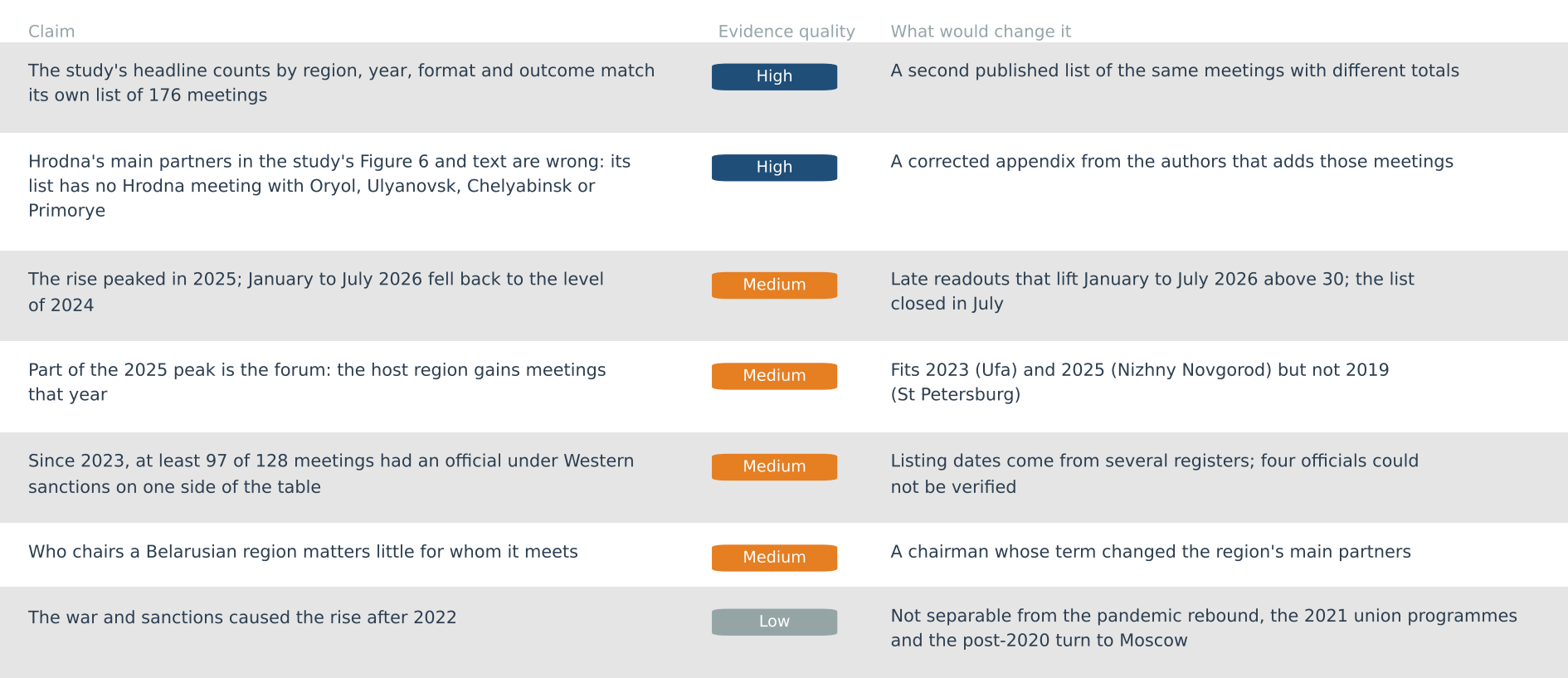
In text: the recount rests on the study’s own list, so the first two rows are firm. The 2026 turn depends on a list that closed in July. Sanctions status comes from several registers, and for two new Belarusian chairmen and two Russian governors we could not confirm it. On the cause of the rise, the data allow several stories.
Watch
Belarusian chairmen and Russian governors hold fewer than 40 meetings in all of 2026, counted by the study’s rules. We expect 30 to 38. Medium. We will count August to December from regional state media by 31 January 2027.
The host region of the 2027 Forum of Regions is among the three Russian regions met most often by Belarusian chairmen in 2027. Medium. Check by 31 July 2027.
The chairmen of Homiel or Mahiliou meet Bryansk’s head at least three times between August 2026 and July 2027. High. Check by 31 July 2027.
The next formal agreement between a Belarusian body and an occupation authority in Ukraine is signed by a council of deputies, not an executive committee. Medium. Check by 30 June 2027.
Method and limits
We copied Appendix 1 of the BIPART study (176 meetings, January 2018 to July 2026) into a table and recomputed every count the study reports. Five rows that the PDF splits across pages were entered by hand. The study’s counts of agreements, of Lukashenko’s meetings and of ideological language rest on lists it does not publish, so we report them as the study’s figures.
For each meeting we identified the chairman in office from appointment reports in Zerkalo, Nasha Niva, Current Time and BelTA. One meeting fell in the month Bryansk changed governors and was left uncoded. A meeting counts as “listed” when the official had been placed on an EU, UK, US, Canadian or Swiss list before the month of the meeting. National lists, such as those of Poland or Estonia, are not counted. Dates come from EU implementing regulations, UK and Canadian lists, Ukraine’s War & Sanctions portal and OpenSanctions (CC BY-NC 4.0). We checked the heads of the twelve Russian regions met most often: the eleven with six or more meetings, plus St Petersburg from the five tied at four. For the other 32 regions the Russian side is not coded, so 97 of 128 is a floor. Two new Belarusian chairmen, Aliaksei Kushnarenka of the Minsk region and Aliaksandr Rahozhnik of Vitebsk, and two Russian governors, Vasily Anokhin of Smolensk and Kovalchuk, are marked as not verified. A chairman of a regional executive committee is an appointed official, and we do not call the post a governorship.
Tagged to thesis T6. Our earlier review of a BIPART study, on the Presidential Administration, is [Two Ledgers].