
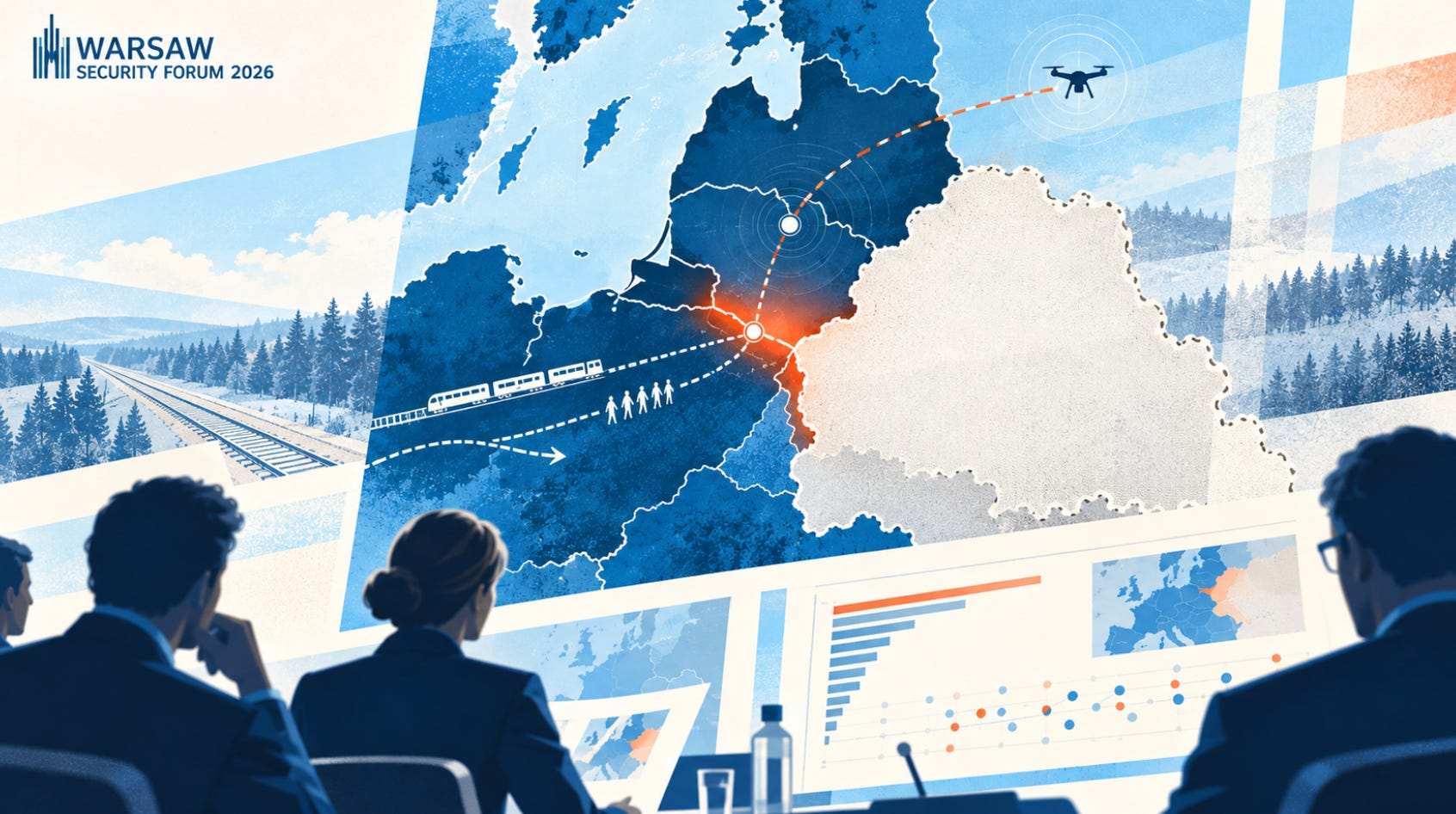
The Warsaw Security Forum opens in Warsaw today, 12 October, and closes tomorrow. Its annual report is a 98-page strategy for nine states, from Iceland to Poland. Its opening claim is geographic. The region holds “the longest continuous stretch of NATO and European Union territory bordering Russia and Belarus”, 3,800 km of land border (p. 11). About 1,250 km of that is the border with Belarus, held by Poland, Lithuania and Latvia. The report names Belarus 12 times in 98 pages, every time next to Russia, and never as a state that does something. The programme of the forum itself gives Belarus three sessions, one of them titled on Belarusian militarisation.
A third of the line
The 3,800 km figure is the report’s own. The Belarusian share comes from the standard border lengths: Lithuania 679 km, Poland 399 km, Latvia 173 km. Together that is about a third of the frontier the strategy is written to defend. The other two thirds face Russia directly, from the Norwegian Arctic to the Polish border with Kaliningrad.
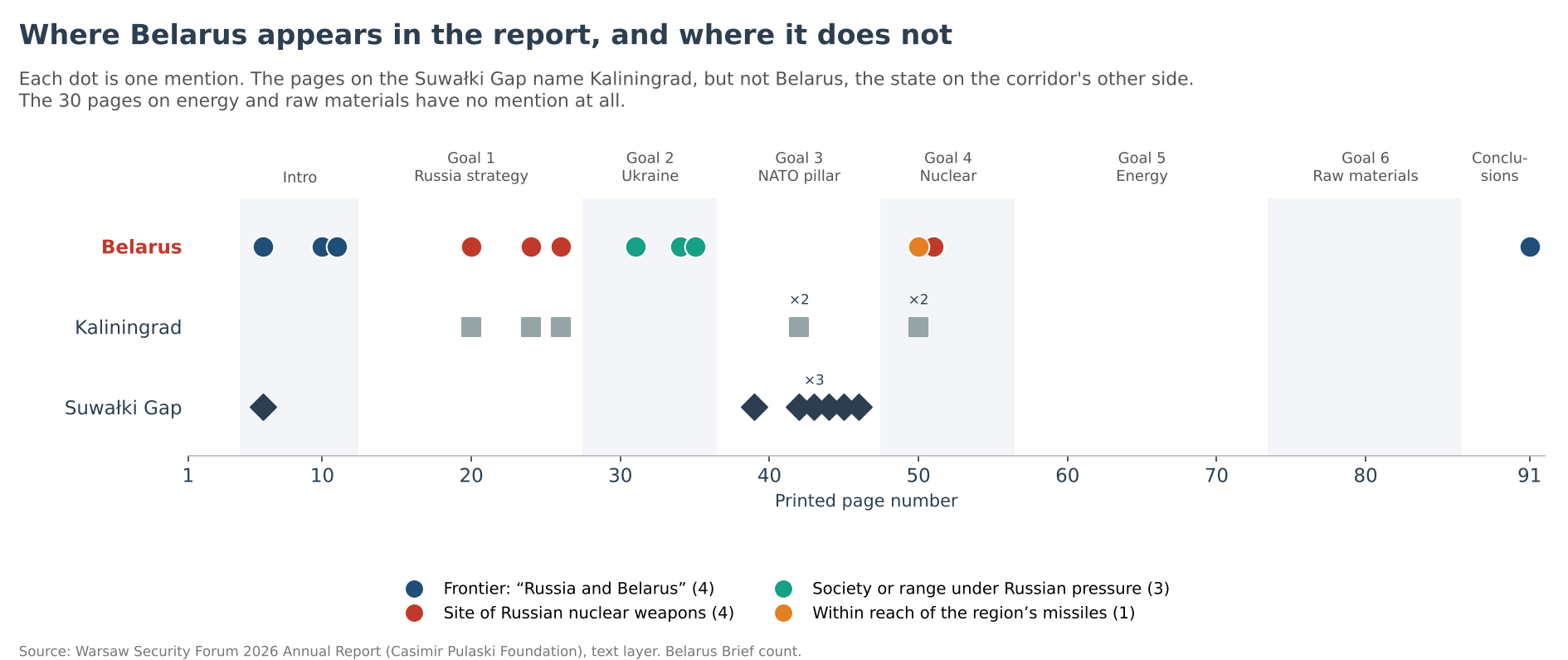
The report treats the two thirds and the one third as one line with one owner. Its four frontier sentences all use the pair “Russia and Belarus” (pp. 6, 10, 11, 91). Its nuclear chapter asks for “the withdrawal of Russian nuclear weapons from Belarus” and “the demilitarisation of Kaliningrad” in the same breath, three times (pp. 20, 24, 26). Its missile chapter notes that the region’s own systems “can already reach Kaliningrad, much of Belarus and north-western Russia” (p. 50). Belarus and Kaliningrad get the same grammar: places where Russian weapons sit, and places the region can hit.
That grammar is defensible on the nuclear file. A Jamestown analysis in January found that the Oreshnik unit in Belarus answers to Russia’s Strategic Missile Forces. Minsk has no real say over launch orders or targets. The weapons are Russian. The report lists Oreshnik among Russia’s new delivery systems (p. 48) and does not say where one of them now stands. On 30 December 2025, Russia’s Defence Ministry announced that Oreshnik had been deployed to Belarus and entered service there. The report’s nuclear map (p. 51) hatches Belarus in Russia’s red and still carries only the Kremlin’s 2023 announcement.
Belarus and Kaliningrad get the same grammar: places where Russian weapons sit, and places the region can hit.
The Gap has two sides
The report’s most concrete military proposal is a controlled air zone over the Suwałki Gap, led by Poland and Lithuania (pp. 43–46). Sensors, interceptors and command would be linked into one network. The Gap is “barely sixty kilometres wide” and carries the LitPol power line and the gas interconnector (p. 43). The pages name Kaliningrad on one side of the corridor. They do not name Belarus on the other.
The two states the report asks to lead that zone are the two with the longest Belarusian borders. The airspace incidents that have reached their capitals in the past year did not come from Kaliningrad. On 20 May 2026, Lithuania’s Defence Ministry declared an alert over a drone that approached from Belarus. Vilnius airport closed for an hour, the president and prime minister went to shelters, and NATO jets scrambled. The report uses that day as a lesson in public warning (p. 52) and gives the drone no direction. In the autumn of 2025, balloons launched from Belarus closed the same airport again and again. Lithuania’s deputy foreign minister called them “a cynical hybrid attack”, and when Lithuania closed its crossings, Minsk kept more than 1,000 Lithuanian trucks on its side. In September 2025, Poland called NATO consultations under Article 4 after about 21 drones crossed its border; Polish press reported that some came via Belarus. The report’s only named airspace case is Russian fighters over Estonia (p. 41).
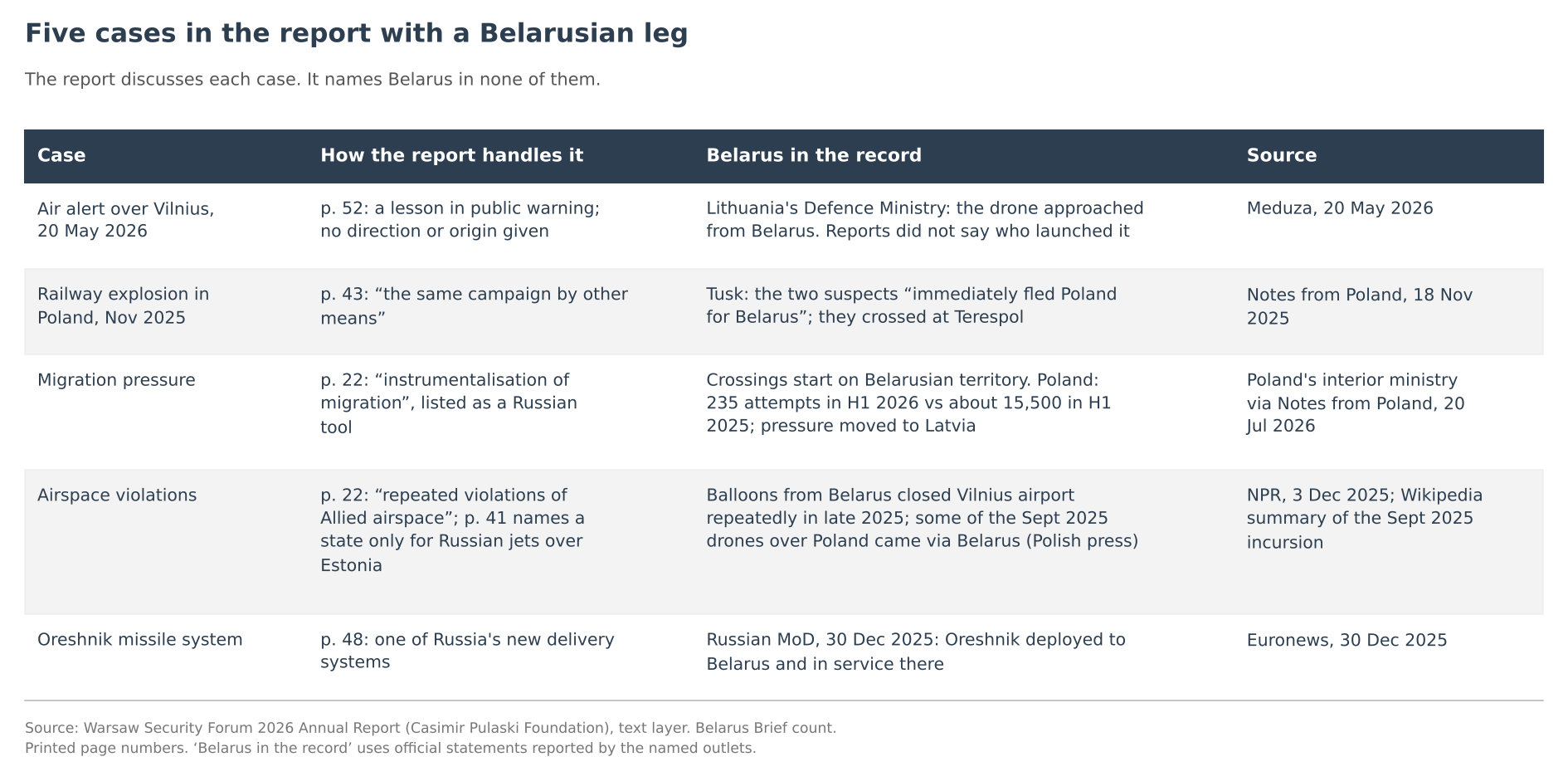
The pattern holds on the ground. The report calls the 2025 railway explosion in Poland “the same campaign by other means” (p. 43). Donald Tusk said the two suspects “immediately fled Poland for Belarus”. The report lists “the instrumentalisation of migration” as a Russian tool (p. 22). The route runs through Belarusian border posts. Poland’s interior ministry counted 235 attempted crossings from Belarus in the first half of 2026, against about 15,500 a year earlier. In the same months the pressure moved north to Latvia and underground into the tunnels we followed in August. A route that closes on one border and opens on another is chosen on the Belarusian side of the fence, whoever pays for it. The words “balloon” and “tunnel” do not appear in the report.
The two states the report asks to lead the air zone are the two with the longest Belarusian borders.
A rule written for Moscow
The sanctions chapter asks the region to resist “premature sanctions relief” and to tie any relief to “verifiable changes in Russian behaviour”, not to talks alone (p. 20). On the Belarusian third of the frontier that moment has passed. Since June 2025 Washington has lifted sanctions in six rounds, each priced in released prisoners: Belavia relief and then its delisting, a potash licence in December, and on 26 March 2026 the removal of Belaruskali with the ban on new state debt, a week after 250 prisoners came out. Two more enterprises followed in September. We set out the full price list two weeks ago. The one lever still in the region’s own hands is transit. Lithuania’s ban on Belarusian potash through Klaipėda stands, and the first post-relief cargo went around it: 30,000 tonnes loaded at Bronka, St Petersburg, on 15 September and due in New Orleans on 14 October, the day after the forum closes.
The report has no line on any of this, for or against. Its rule is written for Moscow. On the Belarusian side of the line the relief has already been granted by the region’s main ally, and the one condition that remains is Lithuanian, not Allied. The report does not say whether its rule applies there.
What the count adds
A count cannot carry a security argument, but it can check one. We read the report’s text layer and split it into sentences. Belarus appears in 12. All 12 also name Russia, Moscow or the Kremlin. In all 12 Belarus follows a preposition or serves as an object; it is never the subject of a verb. Minsk and Lukashenko do not appear in the 98 pages. Lithuania shares a sentence with Russia in 2 of its 20 sentences, Poland in 5 of 59, Ukraine in 23 of 110. Only Kaliningrad comes close, at 6 of 7. The 30 pages on energy and raw materials contain no mention at all.
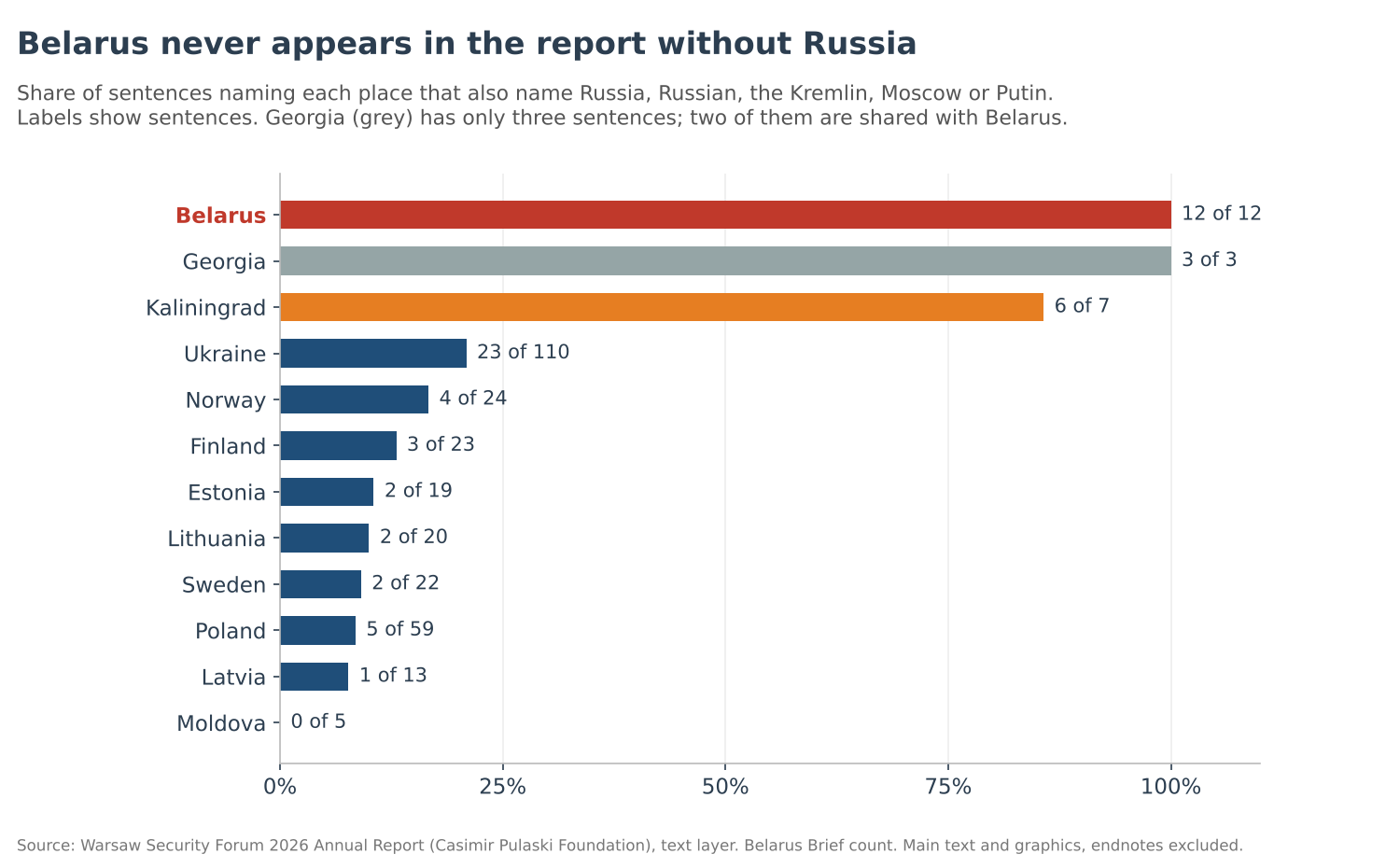
The count confirms what the files show. The report does not avoid Belarus. It folds it into Russia, and it does so at the same rate on the files where that is accurate and on the files where it is not.
The report does not avoid Belarus. It folds it into Russia.
The two floors
The forum has two products. The report is the strategy its authors want nine governments to adopt. The programme is what happens in the rooms, and there Belarus is a subject.
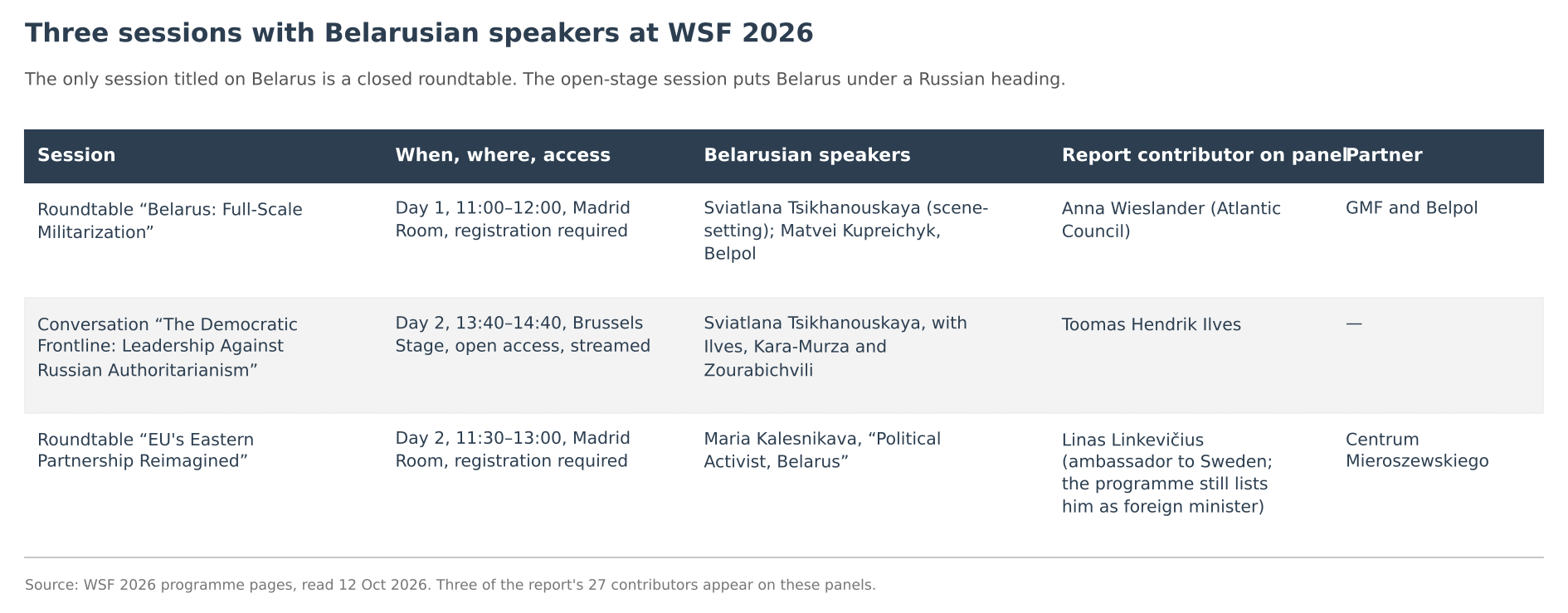
The roundtable “Belarus: Full-Scale Militarization” runs on day one, in the Madrid Room, for one hour, with registration required. Sviatlana Tsikhanouskaya opens it. The speakers include a representative of Belpol, the association of former Belarusian security officers, and GMF and Belpol co-host the session. The open-stage session with Tsikhanouskaya carries a different title, “The Democratic Frontline: Leadership Against Russian Authoritarianism”, and she shares it with Georgia’s and Russia’s democratic figures. Maria Kalesnikava, listed as “Political Activist, Belarus”, sits on the Eastern Partnership roundtable next to Armenia’s foreign minister.
So the forum does let Belarus act, in a particular shape. The Belarusian state as a military actor appears in a closed room, under a title that comes from partners. On the open stage Belarus is a society under a Russian heading, next to Georgia, the pairing the report itself uses on pages 34 and 35.
Three of the report’s 27 contributors sit on these three sessions: Toomas Hendrik Ilves, Linas Linkevičius and Anna Wieslander. They commented on a draft in which Belarus never acts, and they will spend part of the forum in rooms where it does.
The Belarusian state as a military actor appears in a closed room, under a title that comes from partners.
The case for leaving it out
There is a serious reading in which the report is right to fold Belarus into Russia. On the nuclear file, Moscow holds control, and naming Minsk would give it a role it does not have. A second explanation is diplomatic. Poland and Lithuania keep working channels with Minsk on borders, trucks and prisoners. A strategy that named Minsk as an attacker could make those channels harder to use. The text gives no reason either way, and we cannot see the authors’ reasons.
That reading fits the nuclear lines. It fits the Gap and the hybrid files less well. Balloons, migrants and saboteurs cross a border that Belarusian border guards control, and the trucks were held by a decision taken in Minsk. On those files the region’s two most exposed members have already named Belarus. The strategy written for them has not.
How it fits
Observation: a strategy for the states along Belarus’s western border treats Belarus as terrain. It never acts, and no Belarusian is named, Lukashenko included. Fit: consistent with T6, Europe sees Belarus as one man’s country, and it extends the thesis. T6 is tested on media by the share of Belarus items naming anyone besides Lukashenko; in this security document the share is zero for both, so the reduction goes past the one man to the map. On the nuclear file that matches who holds control. On the air-defence, border and sanctions files it does not match what Vilnius and Warsaw have said in the past year. Alternative: the report folds Belarus into Russia only where Moscow holds control, and the hybrid omissions are drafting economy rather than a frame. Separator: the next incident with a Belarusian route. If the region’s joint statements then name Minsk, the folding stops at the military file. If they name only Russia again, it is the region’s general frame, and T6 gains a security-register form.
What to watch
By 31 October 2026, the forum’s own summary of WSF 2026 will name Belarus only in connection with Russia, or not at all, and will carry no readout of the militarisation roundtable. Expected: yes. Confidence: Medium.
By 31 January 2027, Poland’s interior ministry will report fewer than 1,000 attempted crossings from Belarus for July–December 2026, and Latvia will report more attempts than Poland for the same months. Expected: yes. Confidence: Medium.
By 31 December 2026, a second Belarusian potash cargo for the United States will be reported, again loaded at a Russian port and not at Klaipėda. Expected: yes. Confidence: Medium.
By 30 June 2027, if a US-led framework text for a settlement in Ukraine is published, it will not mention Russian nuclear weapons in Belarus or the Oreshnik system. Expected: no mention. Confidence: Medium.
The forum’s 2027 report, due before the next forum, will name Belarus in fewer than 20 sentences, and at least four in five of them will also name Russia. Expected: yes. Confidence: Medium.
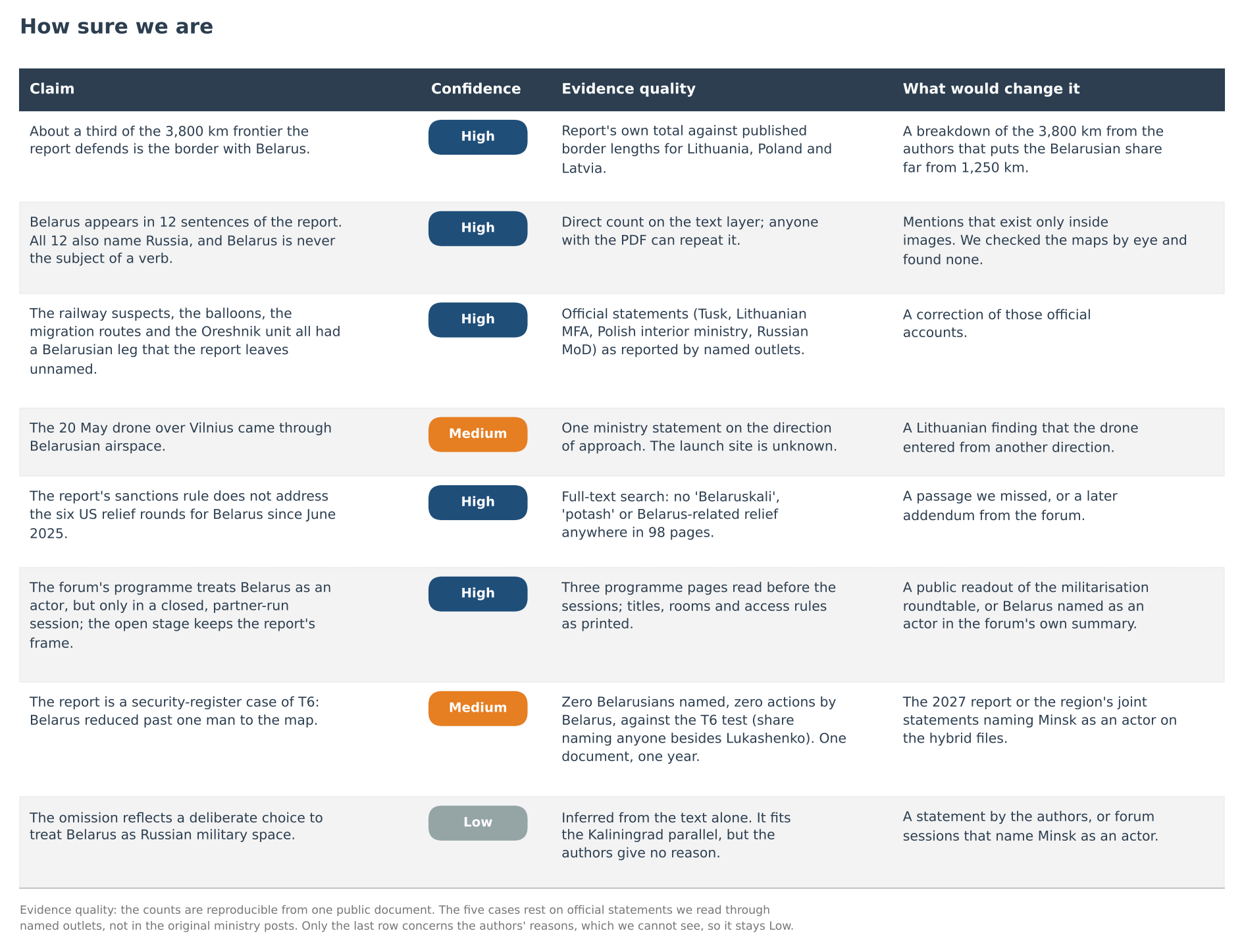
Method and limits. We read the text layer of the report’s PDF (file dated 9 September 2026) and joined words that break across lines. A layout-preserving extraction finds only 10 of the 12 mentions, because two are hyphenated at a line end in the column layout. We split sentences on punctuation, which is rough inside infographics and map captions. “Names Russia” means Russia, Russian, the Kremlin, Moscow or Putin in the same sentence. Page numbers are the printed ones. The co-mention counts cover the main text and graphics, not the endnotes, which contain no mention of Belarus; a different sentence splitter can move a count by one. We checked the maps by eye for labels that exist only as images. The border share uses published border lengths against the report’s own 3,800 km total; the report does not break its figure down, so the share is approximate. The five cases rest on official statements as reported by the linked outlets; for the Vilnius drone, that is a direction of approach, not a launch site. The three session pages were read on 12 October, before the sessions took place; titles, times and affiliations are as the forum printed them. One is out of date: the programme lists Linas Linkevičius as Lithuania’s foreign minister, a post he held in 2012–2020; the report lists him correctly as ambassador to Sweden. A count of mentions measures attention in one document. It does not measure the policy of nine governments. Working Model tag: T6.