

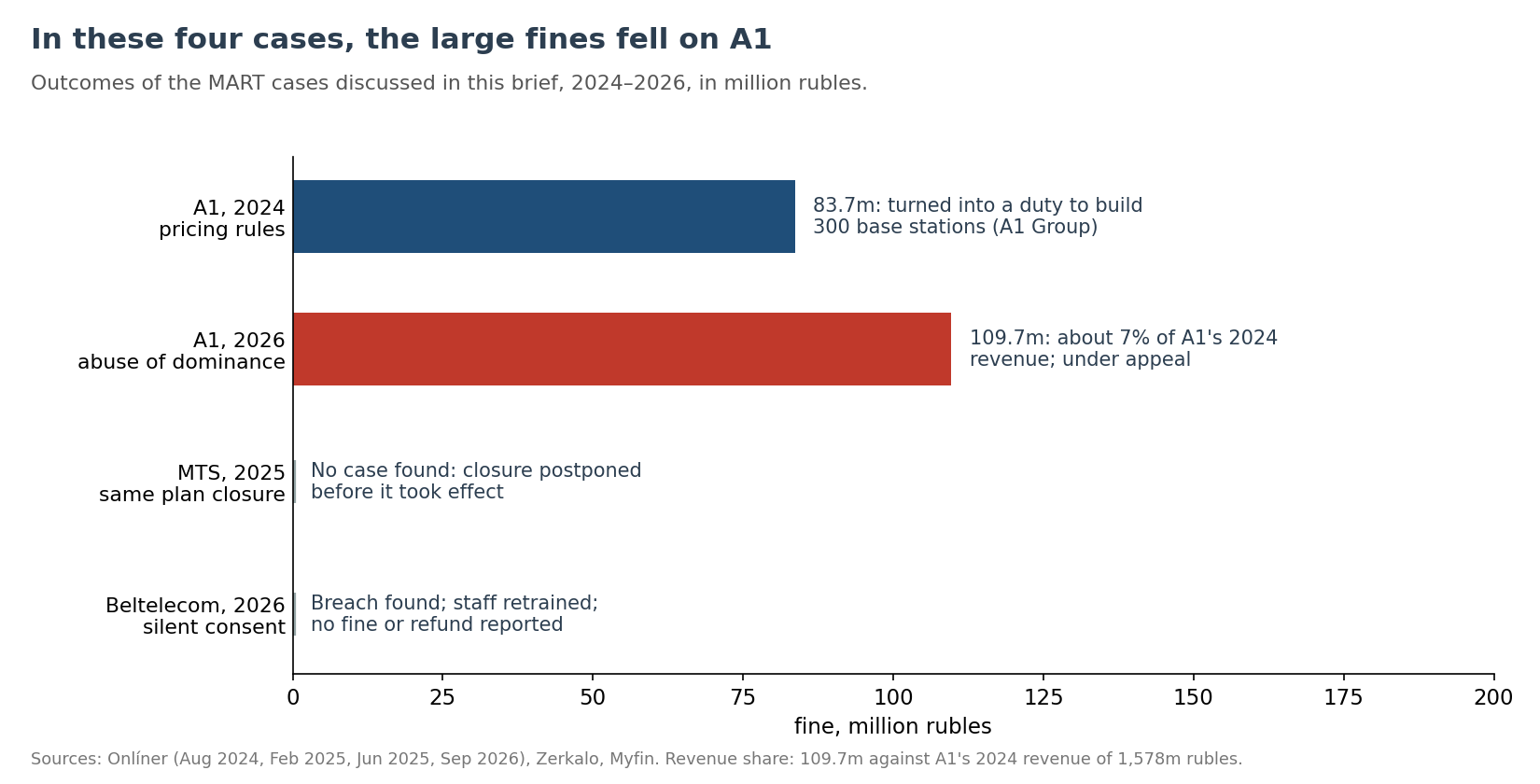
On 28 September Belarus’s Ministry of Antimonopoly Regulation and Trade (MART) announced that a Minsk court had fined A1 109.7 million rubles for closing two old unlimited plans in June 2025 (Onlíner). A1 decided to bring the plans back within a week of closing them, yet the fine equals about 7% of its 2024 revenue. Earlier in the month the same ministry found that state-owned Beltelecom had broken consumer law by treating silence as consent, and closed the case with staff training. What we cannot see is whether the gap between the two outcomes comes from the different laws used or from the different owners, and A1’s appeal is still open.
A1 belongs to the Vienna-listed A1 Group and is one of the largest foreign companies in Belarus (Zerkalo). The end of this case is therefore a public data point for any Western investor still in the country.
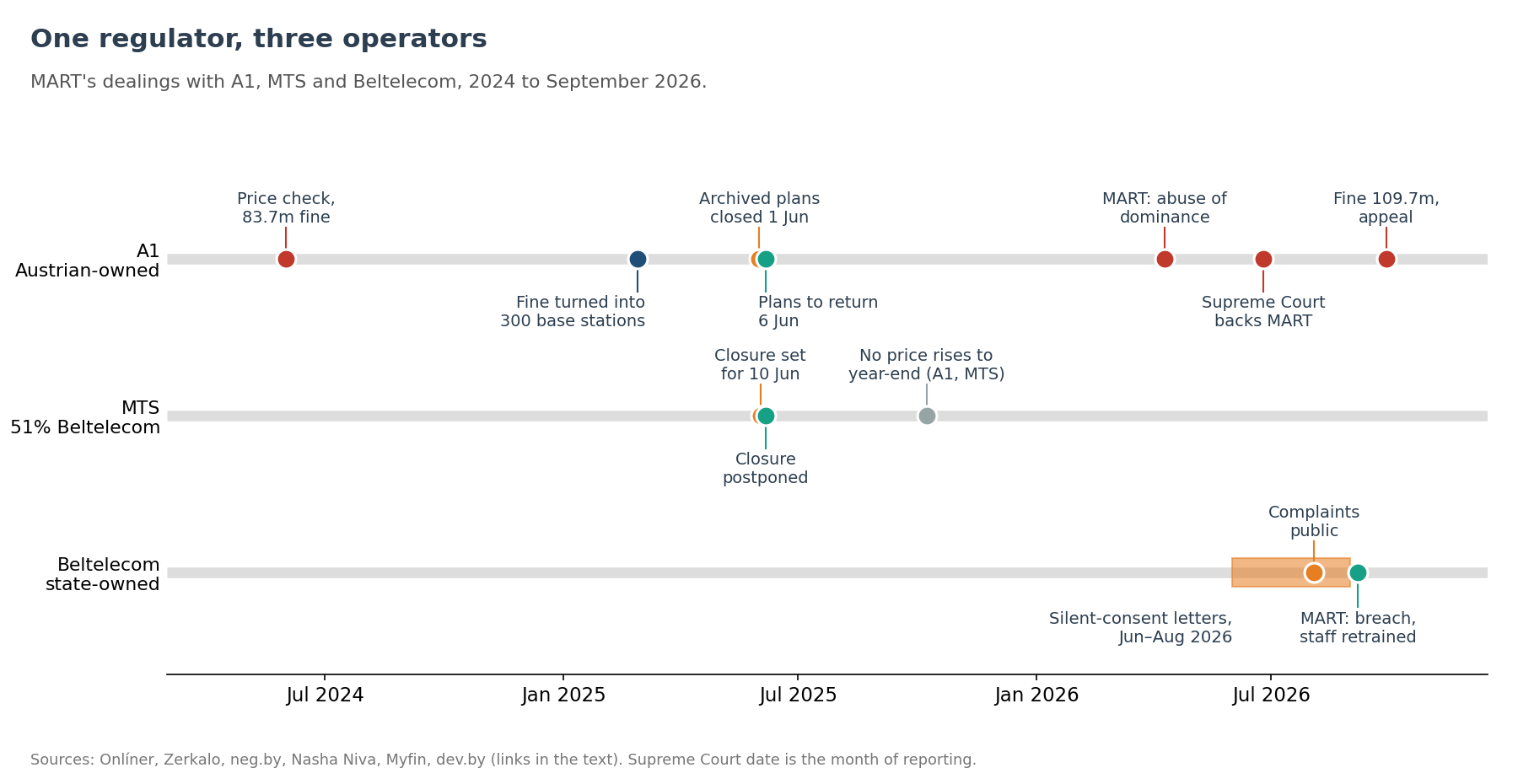
A case that started in June 2025
Our Belarus Internet Watch for September, which supplied the peg for this brief, listed the fine as a September event. It is in fact the end of a sixteen-month case. A1 stopped serving its archived plans “Without Limit” and “Without Limit 2.0” on 1 June 2025 and moved their users to “Drive Unlim” at 39.90 rubles a month (Onlíner). The old plans had cost 27.4 and 29.9 rubles (Zerkalo). After many complaints, MART called A1, MTS and the communications ministry to a meeting on 5 June 2025. On the next day A1 said that it would return all former users to the old plans (neg.by). Users could switch back between 17 and 30 June, and the weeks in between were charged at the old prices.
MART did not stop there. On 10 April 2026 its commission found that A1 had abused a dominant position on the market, and in June the Supreme Court rejected A1’s challenge (Nasha Niva). The fine followed in the Minsk Economic Court, together with 2,250 rubles for an unnamed A1 official. A1 says that the ruling is not yet in force and that it will appeal to a higher court (Myfin).
This is A1’s second large fine in three years. In 2024, after a MART check on its prices, a court fined the company 83.7 million BYN (Onlíner). A1 Group later reported that the fine had been turned into a duty to add 300 base stations from a list agreed with the state. The same report put A1’s Belarusian revenue for 2024 at 1.578 billion rubles, up 9.7% (Onlíner).
A1 decided to bring the plans back within a week of closing them, yet the fine equals about 7% of its 2024 revenue.
The other two operators
MTS is 51% owned by Beltelecom and 49% by Russia’s MTS (Forbes.kz). In the same week as A1, it announced that four archived “Bezlimitishche” plans would close on 10 June 2025 (Nasha Niva). On 6 June, the day after the MART meeting, MTS moved the date back (Onlíner). We found no MART case against MTS. The difference has a plain legal reading: A1’s closure had taken effect, while the MTS closure had not.
A1 Group later reported that the fine had been turned into a duty to add 300 base stations from a list agreed with the state.
Beltelecom’s case is newer. From June to August 2026, two of its regional branches sent letters that offered services such as “Premier” free for a month. After that month, silence would count as consent to a paid subscription under the Civil Code (Zerkalo). A petition on the Udobny Gorod portal asked MART to stop the practice and to return the money. MART agreed that the scheme broke the consumer protection law and the telecom service rules. It treated the breach as fixed, because the letters had “partly incorrect information” and the staff involved were disciplined and retrained (Zerkalo). The reply said nothing about refunds, or about subscriptions added before June 2026.
Read side by side, the two cases look like one rule for a foreign owner and another for the state. The law offers a simpler reading. A1’s case ran under the competition law, which lets a court fine a dominant firm up to 10% of its revenue on the market concerned (dev.by). Beltelecom’s case was a reply to a consumer petition, and MART’s answer did not mention a fine at all. Two cases are not enough to separate these readings.
The reply said nothing about refunds, or about subscriptions added before June 2026.
The operators’ own September news was about the network. MTS reported that it had switched on or upgraded more than 200 LTE base stations in 32 districts over the summer (BelTA). A1 Group’s report for the first quarter of 2026 named Belarus, together with Bulgaria and Croatia, as the strongest contributor to growth in the group’s operating earnings (OTS). In August, in The Goal the Limit Achieved, every dated tariff change we could find since March had gone against the subscriber.
The rest of the sector
Outside telecoms, the month’s numbers point different ways. On 17 September the supervisory board of the Hi-Tech Park, chaired by Prime Minister Alexander Turchin, registered 31 new residents (BelTA). SB.by quoted a park official who said that only a small share of residents still work on contract development (SB.by). A new decree on the park is being tested in state bodies, and its text is not public (Nasha Niva). MacroBY’s monthly estimates, which we used yesterday in After the Combines Left, put growth in the information and communications sector at 0.2% in July and 1.3% in August. MacroBY also warns that Belstat often revises this sector.
Two cases are not enough to separate these readings.
The firms that left show a brighter picture. Vadim Sekhovich reads Polish company registers on his Telegram channel. He counts 217.2 million euros of 2025 revenue for five large Belarusian-founded IT firms in Poland: Innowise, Vention, 314Dev, Andersen and Coherent Solutions. That is 18.5% more than in 2024, with net profit up 14% (businessejby). These are one analyst’s figures in euros, and they cannot be set against Belarusian value added. They do show where part of the sector’s growth is now recorded. Access is another limit. In September Russian developers lost the AI coding tool Cursor after a US export-control clause appeared in its terms, and dev.by reported similar problems in Belarus (Zerkalo).
How sure we are
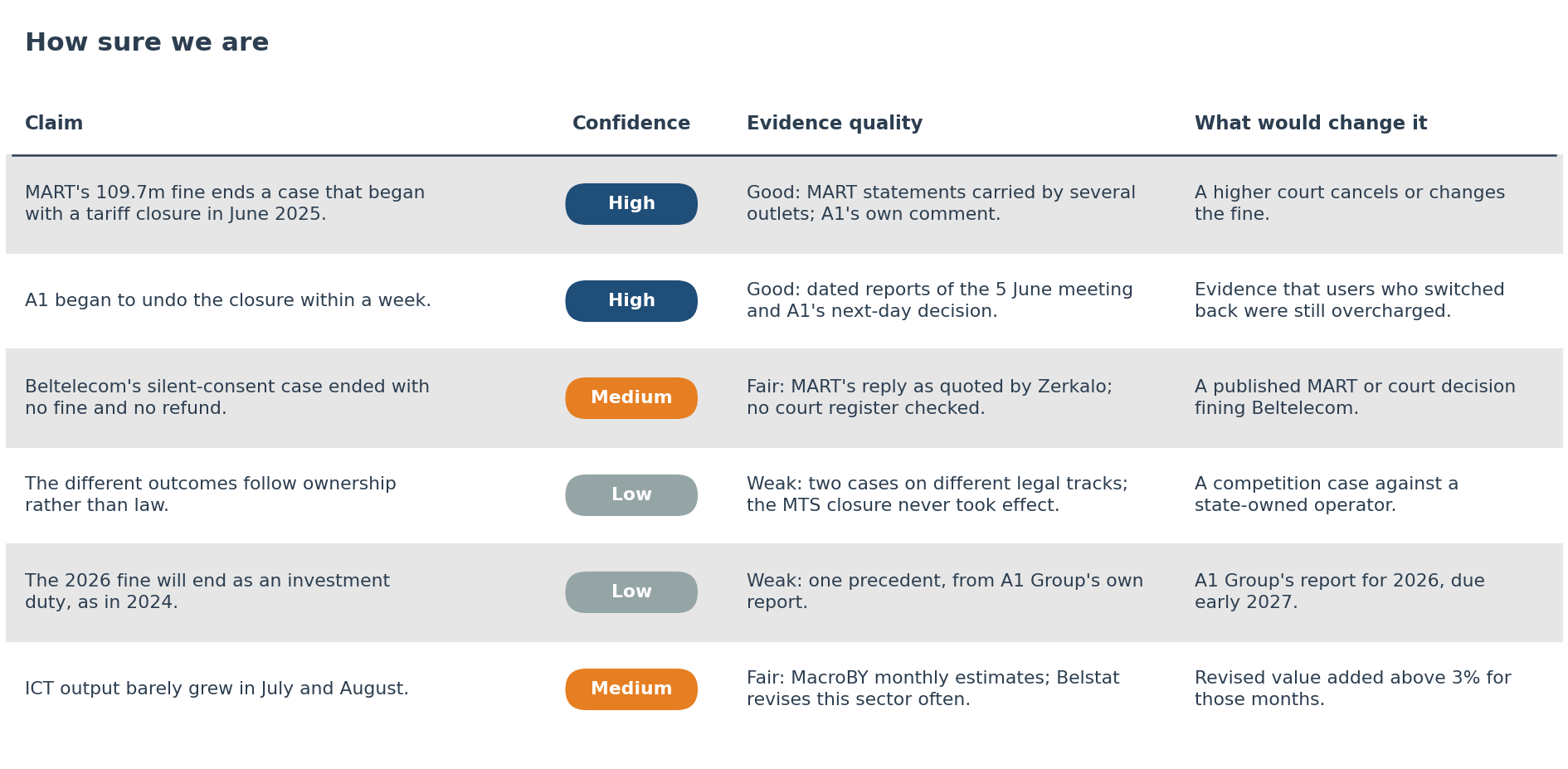
The High rows describe what happened and when. The Low rows are a cause and a forecast, and no document in this brief states either.
How it fits
How it fits. In one month the same regulator fined a foreign-owned operator about 7% of its 2024 revenue, and settled a consumer case against the state operator with staff training. None of the seven theses we test across briefs covers this, since all of them describe media. The data do not rule out a plain legal reading: different laws carry different penalties, and only A1’s closure took effect. A competition case against Beltelecom or MTS, or an A1 consumer case ending without a fine, would favour the legal reading; more large fines on A1 alone would weaken it.
What to watch
By 31 March 2027, a higher court upholds the 109.7 million ruble fine on A1 without reducing it.
A1 Group’s report for 2026, due in early 2027, shows the Belarus fine either reduced in cash or turned into an investment duty, as happened in 2024. We hold this at Low.
By 31 March 2027, MART makes public no competition case against Beltelecom or MTS. If one appears, the legal reading gains.
By 31 December 2026, the new Hi-Tech Park decree is signed and its text published.
Method and limits
The peg came from Belarus Internet Watch for September 2026, monthly review of the digital agenda, built on 66,647 documents from the period. Its telecom theme matched 214 documents, and 59 of them were selected for close reading. The BIW summary dated the A1 fine to 29 September and presented it as a September event. We therefore rebuilt the timeline from dated reports in Onlíner, Zerkalo, Nasha Niva, Myfin, neg.by and dev.by. We did not open MART’s own announcements, and every MART statement here comes through these outlets. The revenue share uses A1’s 2024 revenue as reported by A1 Group. The court may have used a different base, because the law ties the cap to revenue on the market concerned. We did not count state media coverage of either ruling. The brief carries no thesis tag.