

MacroBY’s September Express Analysis estimates that Belarus’s economy grew by about 0.7% year on year in August, after about 5.4% in July. The early harvest, which Belstat named as the cause, explains roughly three-fifths of that fall. The rest came from factories and building sites, which slowed while wages and money kept growing. What we cannot yet see is whether the factory slowdown will last, and who wrote off $1.86bn of Belarus’s public debt.
A harvest that moved
On 21 September, in The Harvest Came Early, we reported Belstat’s figure of 1.9% growth for January to August and its explanation, the timing of the grain harvest. We did not estimate growth for August alone, because Belstat does not publish monthly GDP. MacroBY does, and its estimate of about 0.7% fits Belstat’s own numbers. The cumulative figure fell from 2.1% after seven months to 1.9% after eight, so August had to be far below the average.
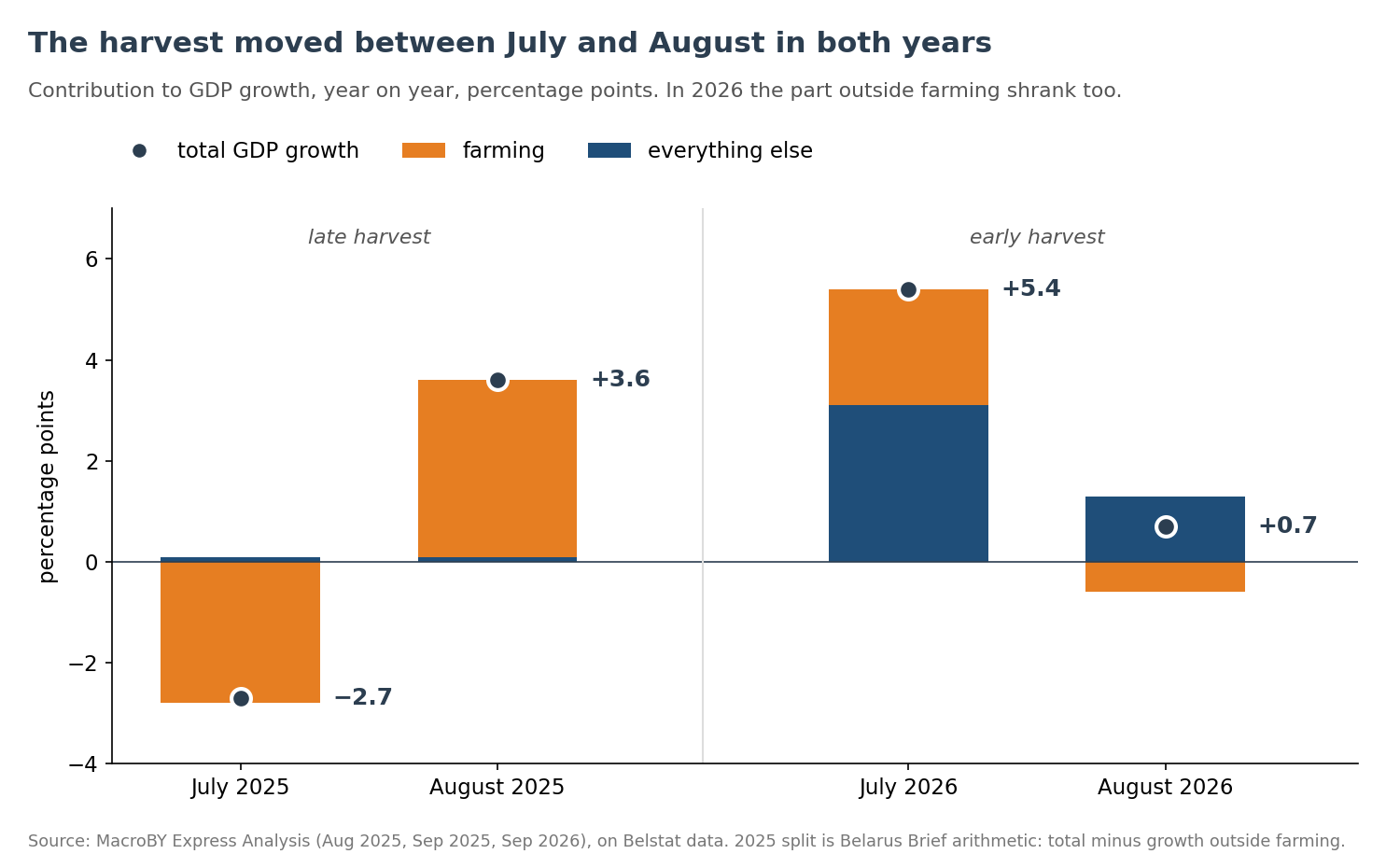
MacroBY’s figures show the harvest effect clearly: farming added 2.3 percentage points to annual growth in July and took away 0.6 points in August. That swing of 2.9 points is about three-fifths of the 4.7-point fall in headline growth. In August alone, farm enterprises harvested 23.7% less grain, rapeseed included, than in August 2025, because much of the crop had already been cut in July.
A poor harvest would produce the same August figure. The data point more to timing: by 1 September the total grain harvest was close to last year’s. MacroBY credits that to more rapeseed and a larger sown area, so weaker yields may explain a small part of the August drop.
Last year’s calendar matters as much as this year’s, because in 2025 the harvest was late. MacroBY’s notes for August 2025 and September 2025 put growth at −2.7% in July 2025 and +3.6% in August 2025, with growth outside farming at about 0.1% in both months. This summer therefore compares an early harvest with a late one, and the monthly rates carry both calendars. Over two years, by our arithmetic on MacroBY’s estimates, output rose about 2.6% to July 2026 and about 4.3% to August. On a two-year view, August was the stronger month.
Outside the fields
Outside farming, growth fell from about 3.1% in July to about 1.3% in August. Last year’s calendar cannot explain this drop, because growth outside farming was flat in both months of 2025. Manufacturing slowed from 4.5% to 0.8%, and its contribution to growth fell from more than 0.8 points to less than 0.2. Construction went from 7% growth to a small fall of 0.3%, the sharpest turn of any sector in MacroBY’s breakdown outside farming.
On a two-year view, August was the stronger month.
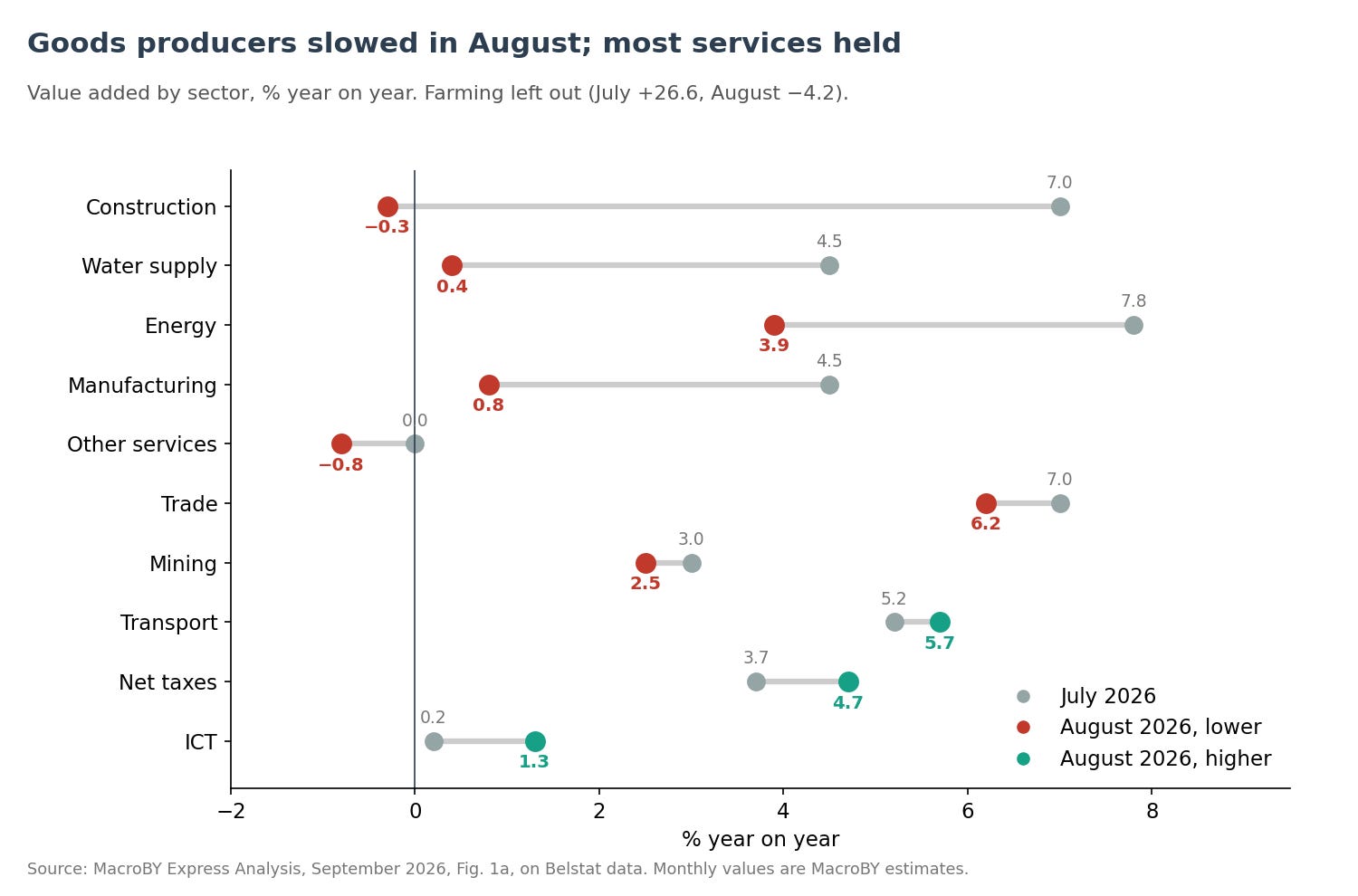
Services held up better, with trade growing 6.2% in August and transport 5.7%. The information and communications sector grew 1.3%, and MacroBY thinks its recovery after the downturn of 2022–2023 has stalled. It also warns that Belstat often revises this sector, so the reading needs a second estimate. We looked at one part of that sector in The Work That Travels.
For the factories, MacroBY points to weak investment demand in Russia, where logistics have also become harder, along with a shortage of workers at home. The note is careful on the details: on machinery, it says that sales problems “can be assumed”, a sign that it has no firm-level data. Firms that sell at home kept growing: food processing rose 4.3% in January–August and pharmaceuticals 8.5%, while light industry fell 7.9%.
A second reading fits the same numbers, because stocks of finished goods fell in August but stayed at historically high levels. Factories with full warehouses often cut output until they sell what they already have. That would slow production for some months even if Russian demand did not change. Both readings can be true at once, and September’s industry data will help to separate them.
For construction, MacroBY gives the usual explanation: output jumps from month to month as new buildings are handed over. A pause in state-funded projects would look the same in a single month, and the investment series does not yet show which one it was.
Demand kept going
Demand at home went the other way: real wages have grown for 30 months in a row, from February 2024 to July 2026. In August, retail sales were about 38% above their 2021 average, and non-food sales more than 65% above it. Retail did fall back in August after strong growth, but it stayed high. Household lending has picked up again this year, and lending rates fell below 10% in August.
Last year’s calendar cannot explain this drop, because growth outside farming was flat in both months of 2025.
Broad money grew 20.6% year on year in August, while the economy grew 0.7%. MacroBY expects money to grow by more than 20% for the whole year and calls the difference a money overhang: cash and deposits that people could spend later. So far, the note says, high household saving has held that spending back, although further cuts in interest rates could weaken that restraint. That saving is not spread evenly. In Household Finances Under Pressure, we reported a MacroBY survey in which about 30% of people whose income had fallen were missing obligatory payments, up from 6%.
Price controls are the other restraint: food prices outside fruit and vegetables rose at an annual rate of 2.1% in August, where MacroBY describes control as almost complete. Non-food goods were freed from control in mid-July, and their price growth then slowed from 9.4% in July to 6.3% in August at an annual rate. MacroBY reads this as a sign that the gap between goods and services prices is structural, linked to the growth of online marketplaces. The competing reading is simpler: two months is too short, and shops may raise prices once they see how buyers react. Annual inflation was 4.5% in August, and MacroBY expects 5–6% for this year and 6–7% for 2027.
The creditor without a name
Part of the spending money has an unusual source: MacroBY says that about $1.86bn of Belarus’s public debt was forgiven in the second quarter, “likely by Russia”. It expects this to let the government put more budget money into public investment. This is a heavy year for repayments: the government planned about 23.7bn rubles, close to $8bn, for repayments and interest in 2026, Zerkalo reported.
Broad money grew 20.6% year on year in August, while the economy grew 0.7%.
We could not confirm the creditor, because the Finance Ministry has kept its debt data closed since 2022, as Zerkalo notes. The Russian decisions we found on the public record were all deferrals, starting with about $1.4bn of payments that Moscow moved to 2028–2033 in 2022, Nasha Niva reported. Smaller deferrals followed, of about $800m in 2025 and about $250m in January 2026, and each needed ratification by the Russian parliament. A Russian write-off would probably need the same, and our search did not find one.
In March, at a meeting on the National Bank, Lukashenko said the loans the country had taken needed a substantial decision, according to Zerkalo. We cannot link that remark to the write-off. Other operations can also lower a debt figure, for example when a loan is turned into another kind of obligation. Until a document names the creditor, both the word “forgiveness” and the name “Russia” are MacroBY’s reading.
Props that may not last
The trade balance also rests on factors that MacroBY calls temporary. In July, a goods deficit of about 4.3% of GDP was covered by a services surplus of the same size, supported by refining Russian oil under tolling deals. The note names the other supports, including a fuel shortage in Russia, higher commodity prices after the Hormuz Strait crisis and a wider gap between fuel and crude prices. They also include a Belarusian ruble that is cheap against the Russian ruble, while the Russian ruble is expensive against the dollar. MacroBY expects a trade deficit of about 1% of GDP for the year, growing as these factors fade.
Until a document names the creditor, both the word “forgiveness” and the name “Russia” are MacroBY’s reading.
MacroBY’s own July forecast described the other side of that risk: if the tolling deals continue into 2027, growth and the ruble would be stronger than in its baseline.
Potash exports run close to record levels, at about 12m tonnes a year. At that pace, the 30,000-tonne cargo to New Orleans that we covered in The Same Day, Told Twice equals less than one day of exports.
The decree and the forecast
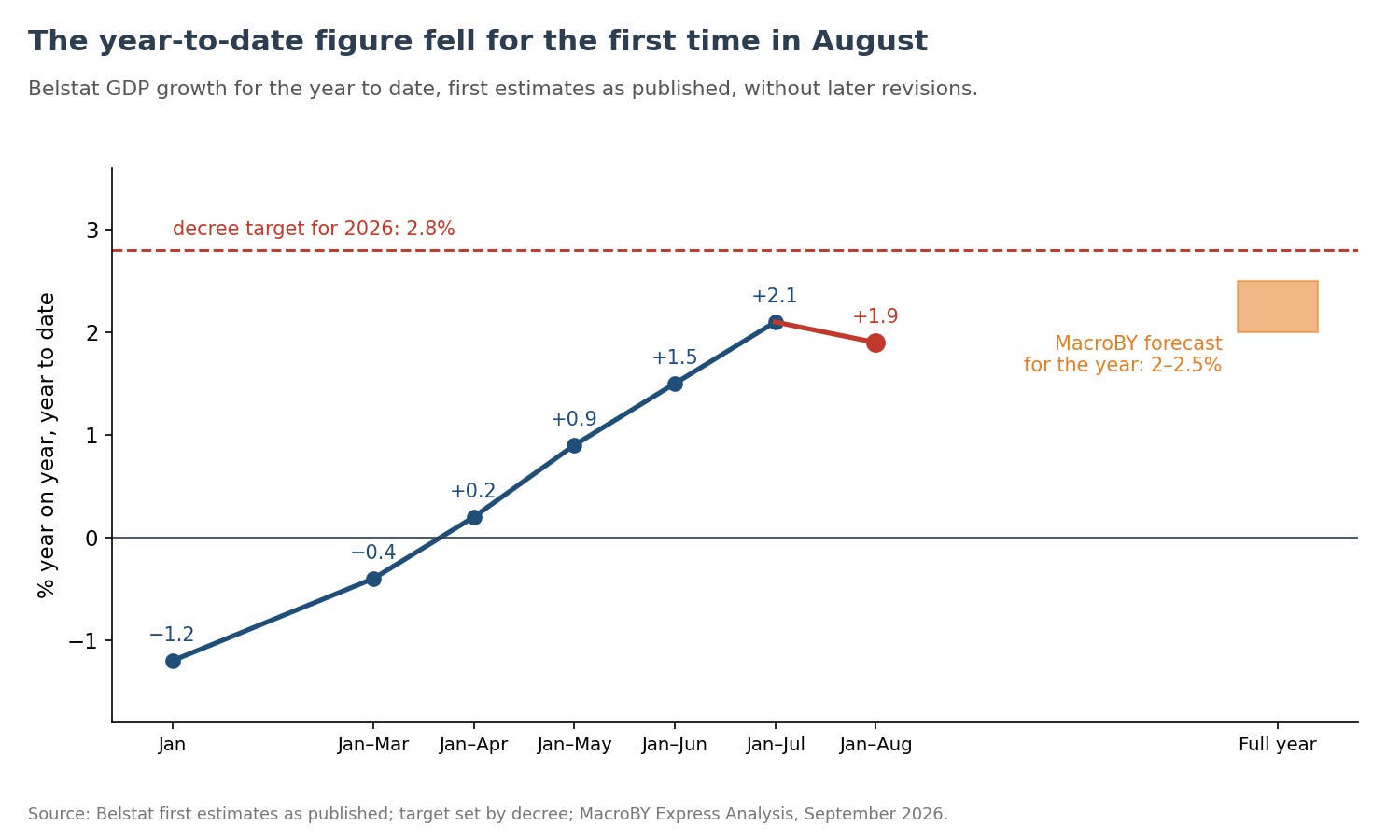
The cumulative growth series that we followed in Climbing Toward the Decree rose every month this year. It opened at −1.2% in January and −0.4% for the first quarter, then went to 0.2%, 0.9%, 1.5% and 2.1% by July. In August we wrote that the climb had no reversal, and it has one now: 1.9% for January to August.
The official target, set by decree, is 2.8% for 2026, and by our rough weighting reaching it would need growth of more than 4% from September to December. MacroBY’s forecast of 2–2.5% for the year implies roughly 2–3.5% for those months. MacroBY has raised the lower end of its forecast twice this year: from 0.5–1.5% at the start of the year to 1.5–2.5% in July, and to 2–2.5% after the July data. The decree is still above its highest figure, and last year’s gap was wider: a target of 4.1% against an outcome of 1.3%.
How sure we are
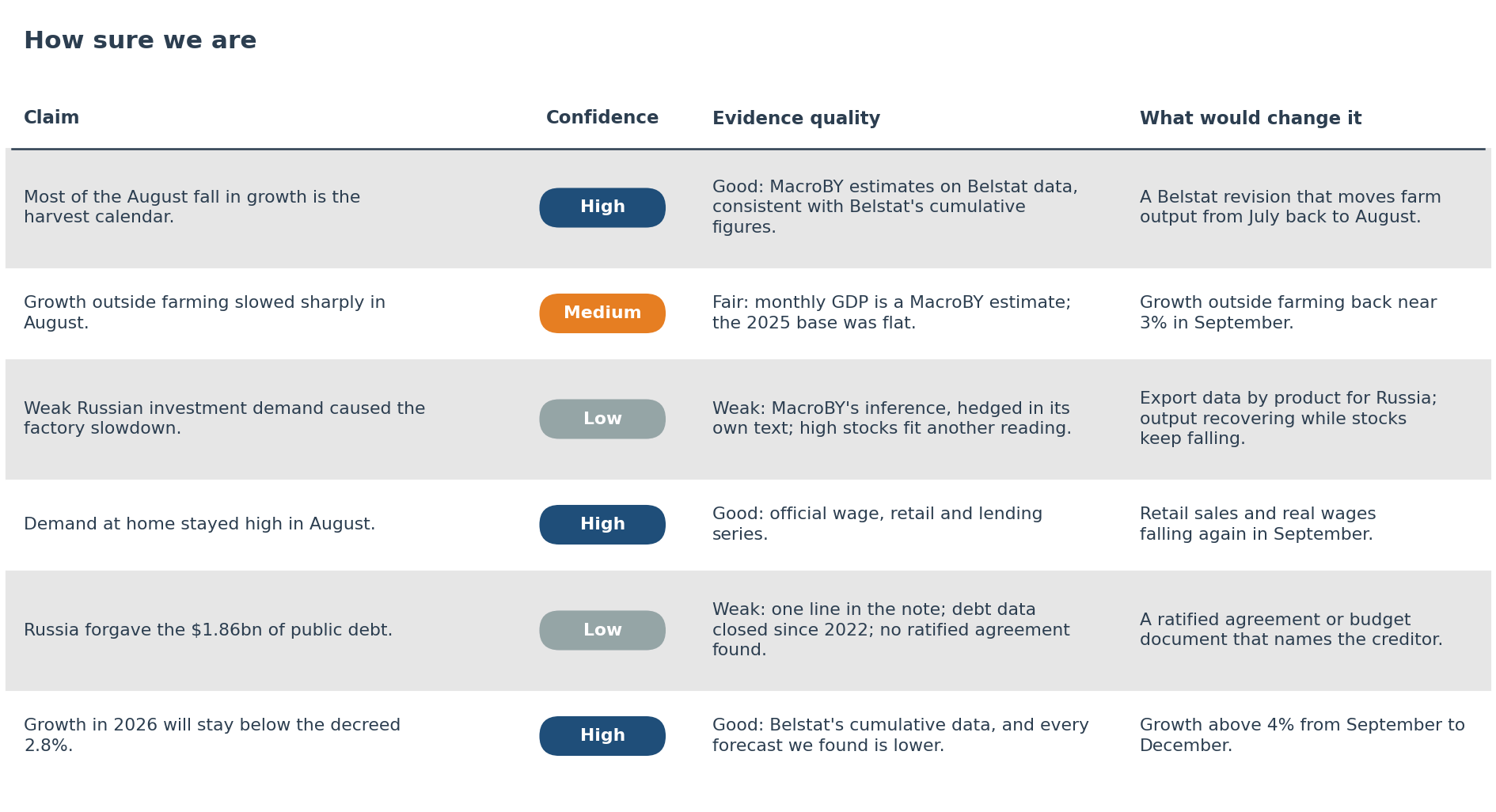
The High rows rest on Belstat series, even where MacroBY does the monthly estimate, while both Low rows are about causes. The weaker of the two is the debt write-off, which rests on one sentence in the note and on no document that we could find.
What to watch
By 23 October 2026, Belstat’s first estimate for January–September growth stays below 2.1%, the January–July level. A figure of 2.1% or more would mean the factory slowdown did not continue into September.
In Belstat’s release for September, due in the second week of October, annual inflation falls inside MacroBY’s range of 4.5–4.8%.
By 31 December 2026, a ratified agreement or a budget document names the creditor behind the $1.86bn. If none appears, the “likely Russia” reading stays unconfirmed.
In Belstat’s first estimate for the full year, due in January 2027, growth for 2026 is below the decreed 2.8%. We expect it inside MacroBY’s range of 2–2.5%, with less confidence.
Method and limits
This brief reads MacroBY’s Express Analysis for September 2026, a six-page note, with its August and September 2025 notes for last year’s base. Belstat publishes only cumulative GDP, so every monthly growth rate here is a MacroBY estimate, and MacroBY revises these as data are checked. The two-year rates and the 2025 farm share in the first chart are our arithmetic on MacroBY’s published estimates, and the 2025 figures are first estimates. Two-year rates remove last year’s calendar but keep that of 2024, which had its own harvest shift. The September–December requirement uses rough weights, with January–August at about 63% of annual GDP. The cumulative series uses Belstat’s first estimates as published, without later revisions. No corpus count stands behind this piece, and the debt search covered open sources in Russian and English only.