

Every week our digest sorts Belarusian coverage into sixteen topics and records how much of each comes from state outlets and how much from independent ones. Fifteen of the sixteen sit where they always sit, or wobble. Culture has moved one way for five weeks running. In early August the state held 23% of it. In the week of 31 August to 6 September it held 65%.
The series
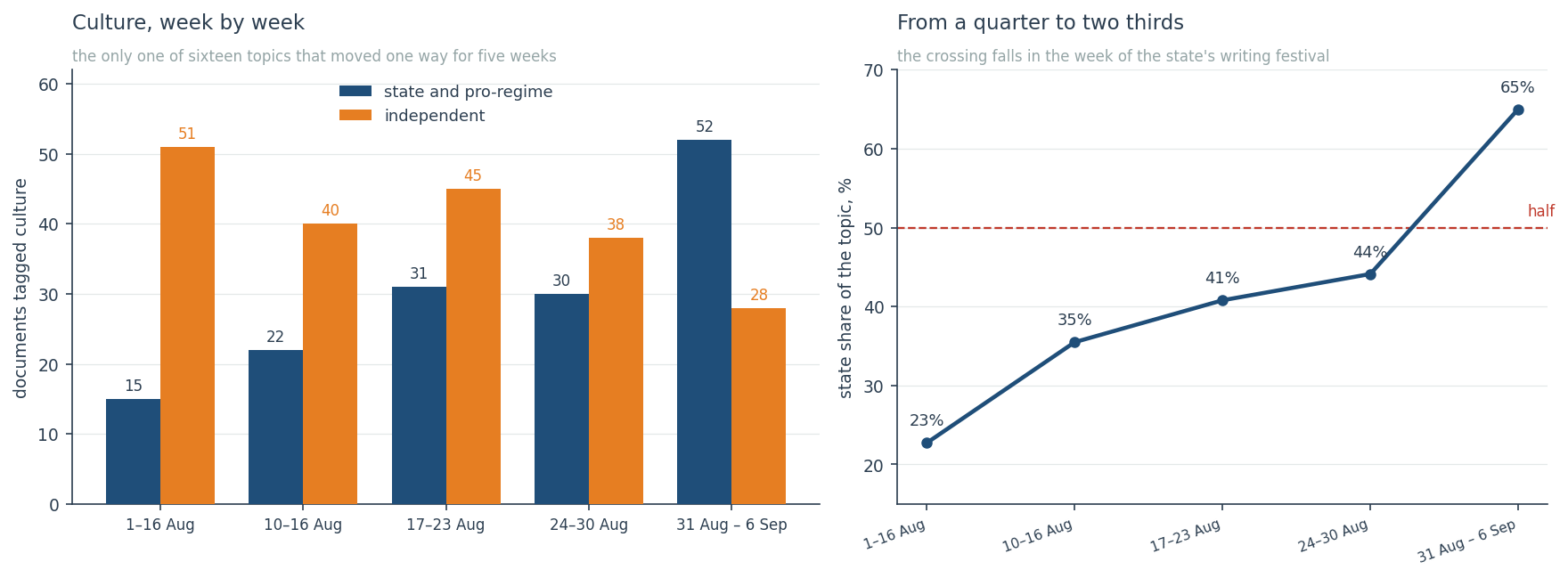
In the first half of August, state and pro-regime sources produced 15 documents that the digest tagged as culture, against 51 from independent outlets. The next readings ran 22 against 40, then 31 against 45, then 30 against 38. In the week just past: 52 against 28.
No other topic behaves like this. Russian integration and the Global South stay with the state every week. Democratic forces and Western dialogue stay with independent media. Military and education coverage swings back and forth without direction. Culture went one way, five weeks in a row, and crossed over.
The crossing falls in a particular week. The XXXIII Day of Belarusian Writing opened in Kostyukovichy on 5 September with about 600 performers and a greeting from Lukashenka, who called it a festival of distinctive national culture. Two days earlier SB, the government daily, presented him as the author of a concept of cultural sovereignty resting on care for the purity of the native tongue.
Twenty-three per cent in early August. Sixty-five in the first week of September.
What was underneath
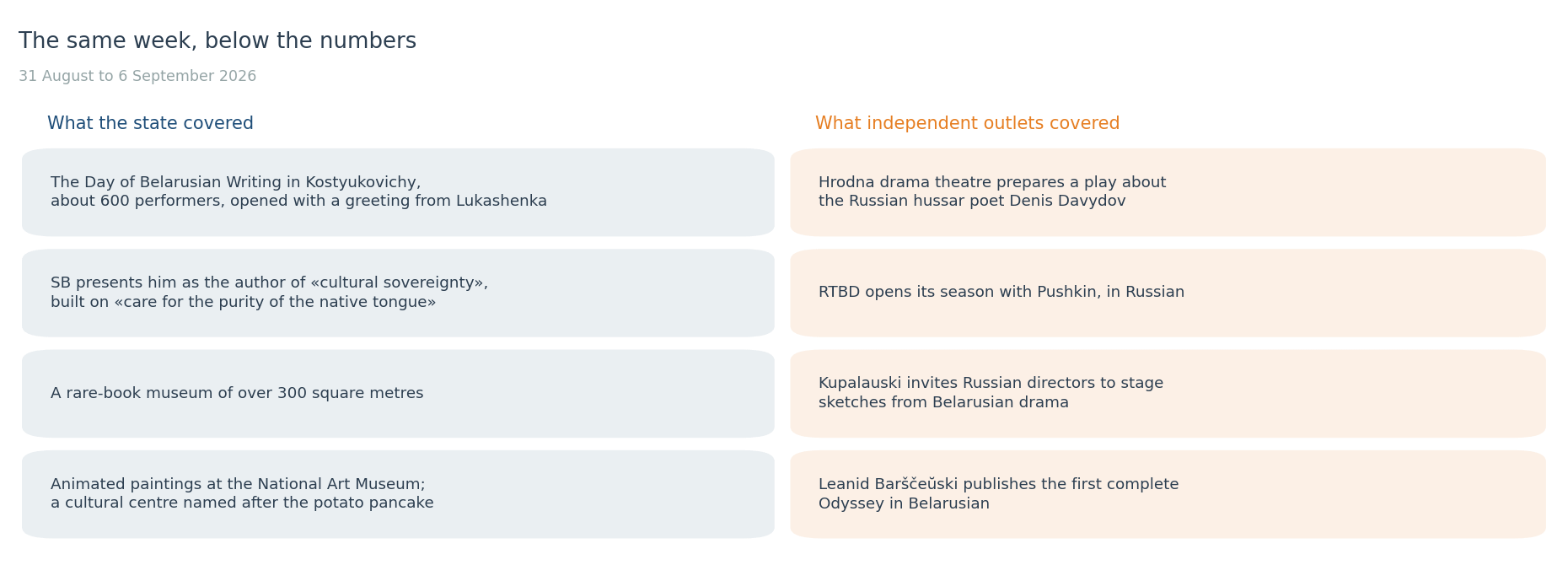
The volume moved one way. The substance moved the other.
In the same week, independent outlets reported that the Hrodna drama theatre is preparing a play about Denis Davydov, a Russian hussar and poet of the Napoleonic wars. The Republican Theatre of Belarusian Drama opened its season with Pushkin’s Little Tragedies, in Russian. The Kupalauski theatre announced a laboratory where Russian directors will stage sketches drawn from Belarusian drama.
Also in the same week, Leanid Barščeŭski published the first complete translation of the Odyssey into Belarusian.
So the festival of the native tongue took place in a week when a state theatre was rehearsing a Russian poet, the national drama theatre had opened in Russian, and the largest Belarusian-language literary event was a translation published by a man who lives in exile.
A festival of the native tongue, in a week when the national drama theatre opened in Russian.
The largest Belarusian-language literary event of the week was published from exile.
What the numbers do and do not mean
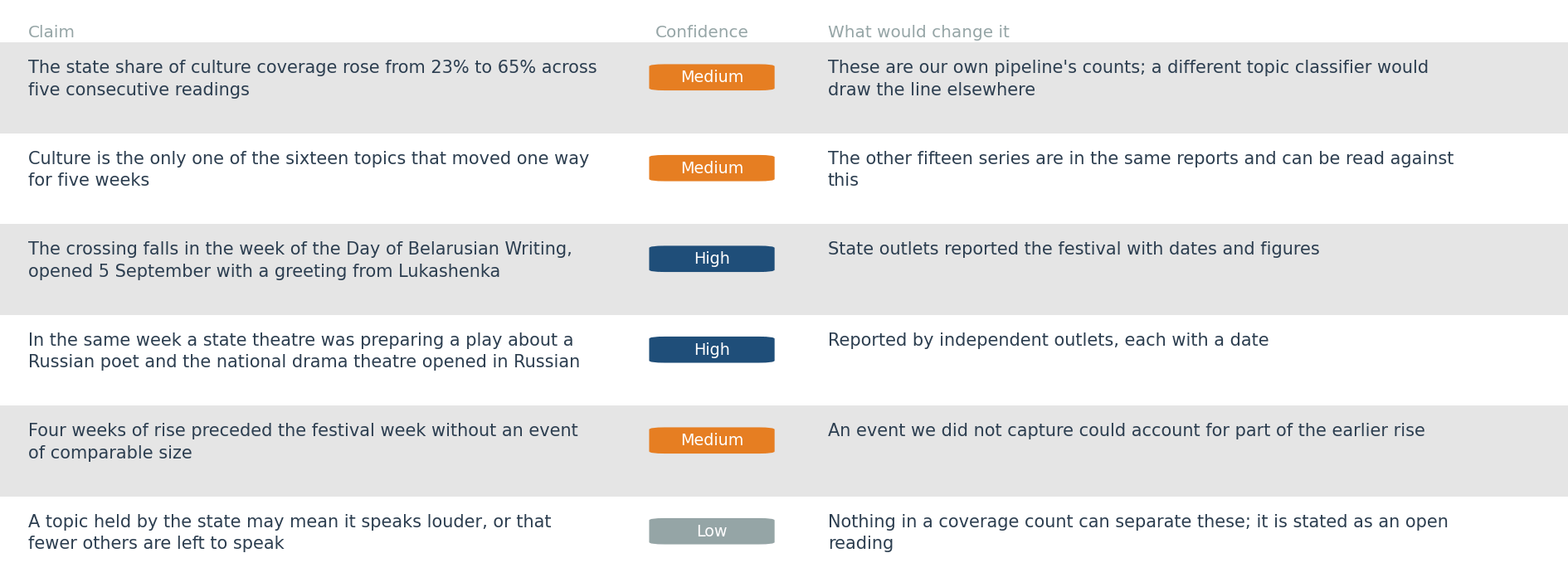
They do not mean the state is producing more culture. They mean the state produced more coverage tagged as culture, in a week when it was holding its own cultural festival. Festivals generate press releases, and a state with a large press apparatus can dominate any topic on the day it chooses to.
What is harder to explain away is the four weeks before. The share moved from 23% to 35% to 41% to 44% before the festival week, without a single event of that size. Something was rising steadily and the festival finished the job.
And there is one reading the numbers cannot settle. A topic held by the state may mean the state is speaking loudly, or it may mean the other side has less left to report on. Over the same period we counted more than 2,000 organisations closed, seven manor houses struck from the heritage register, and a rule that will put the security service at the entrance to any new one. Those are not cultural stories in the tagging, but they remove the people who make cultural stories.
They remove the people who make cultural stories.
Confidence
Watch
The state share of culture falls back below half in the next two weekly readings. If it does not, the festival was not the cause.
Another of the sixteen topics shows a five-week monotonic move. So far none has.
A Belarusian state theatre announces a premiere in Belarusian for this season.
The Day of Belarusian Writing generates a published figure for attendance or cost, which would allow the coverage to be set against the event.
Method and limits
The weekly balance comes from our own digest pipeline, which assigns each document to one of sixteen topics using a language model. We are therefore measuring what that pipeline calls culture, not culture. A different classifier would draw a different line, particularly between culture, education and ideology, which overlap.
The five readings are not identical windows. The first covers 1 to 16 August and the rest are single weeks, so its counts are not directly comparable to the others; the share it gives is, which is why the second chart uses shares.
Document counts reflect what our collectors hold, and collection is not equally complete across sources. The direction of the series is the claim here, not the exact percentages.