

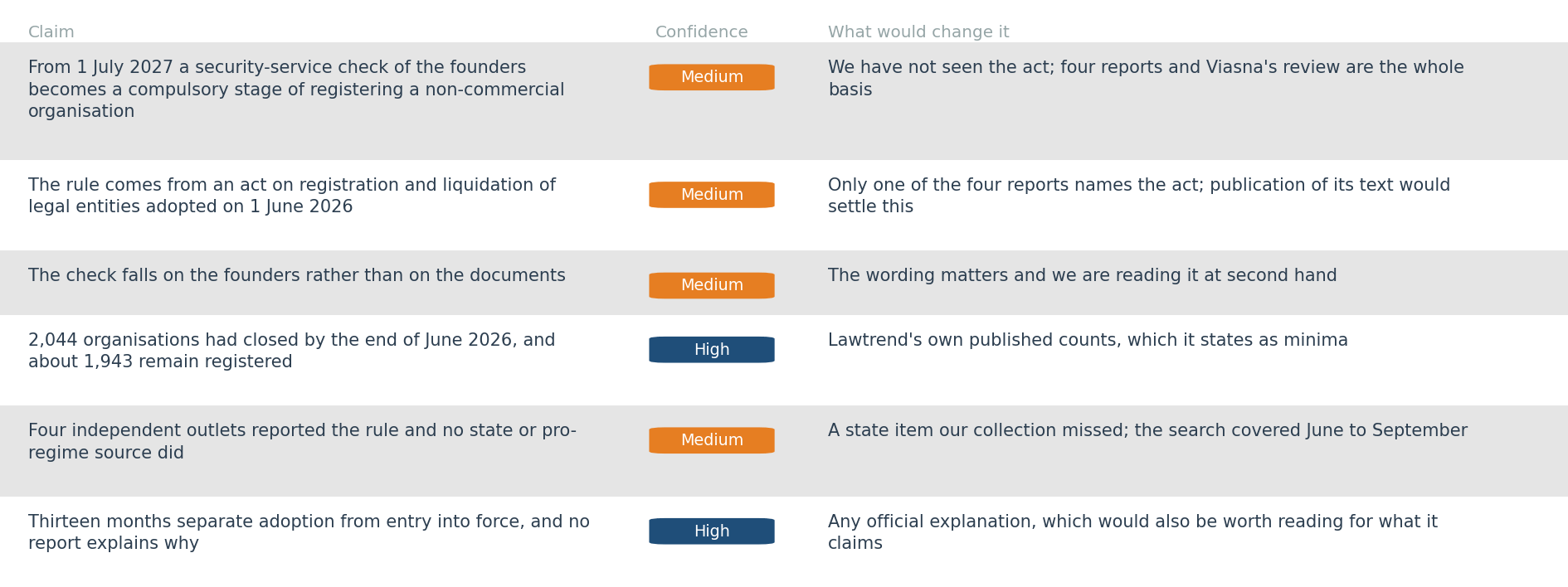
From 1 July 2027 the security service will check the people who found a Belarusian non-commercial organisation before it can register. The check falls on the founders, not on the organisation. The rule comes from an act on the registration and liquidation of legal entities adopted on 1 June 2026, and covers private institutions, associations and unions. Four independent outlets reported it. The state press did not.
The exit was closed first
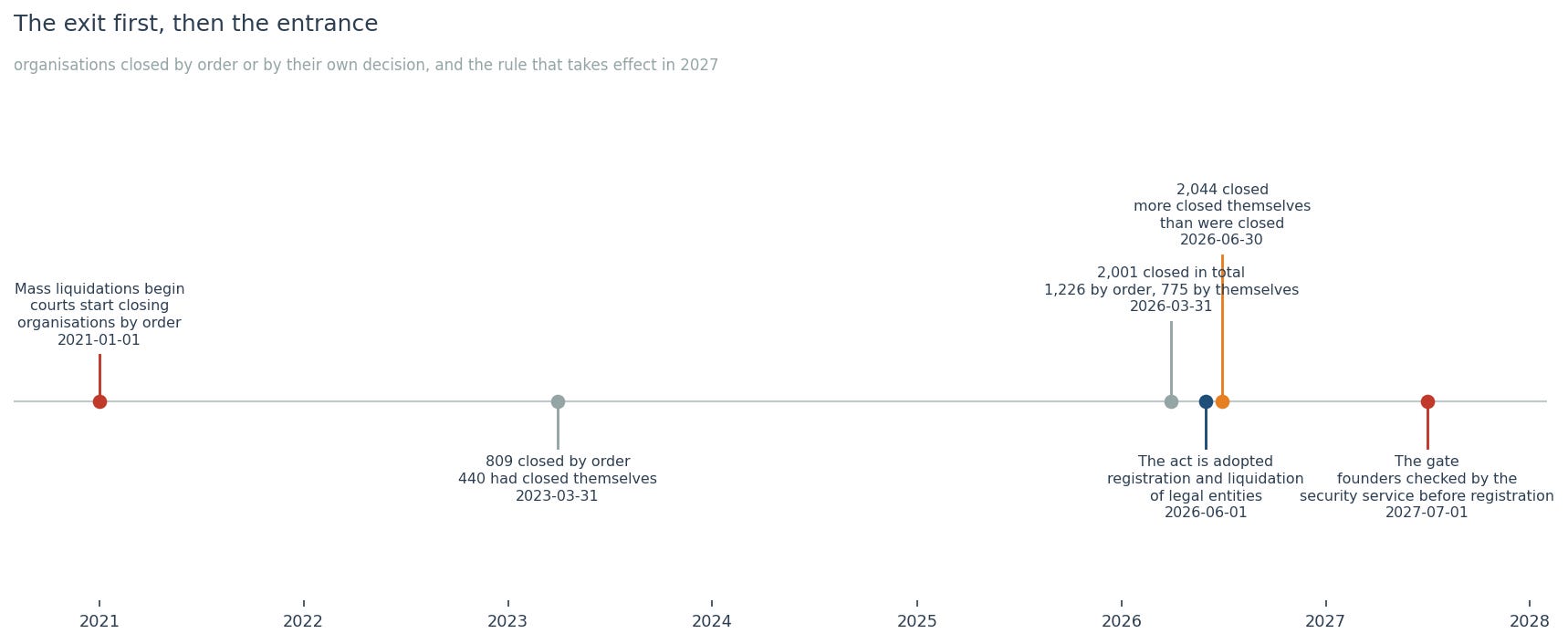
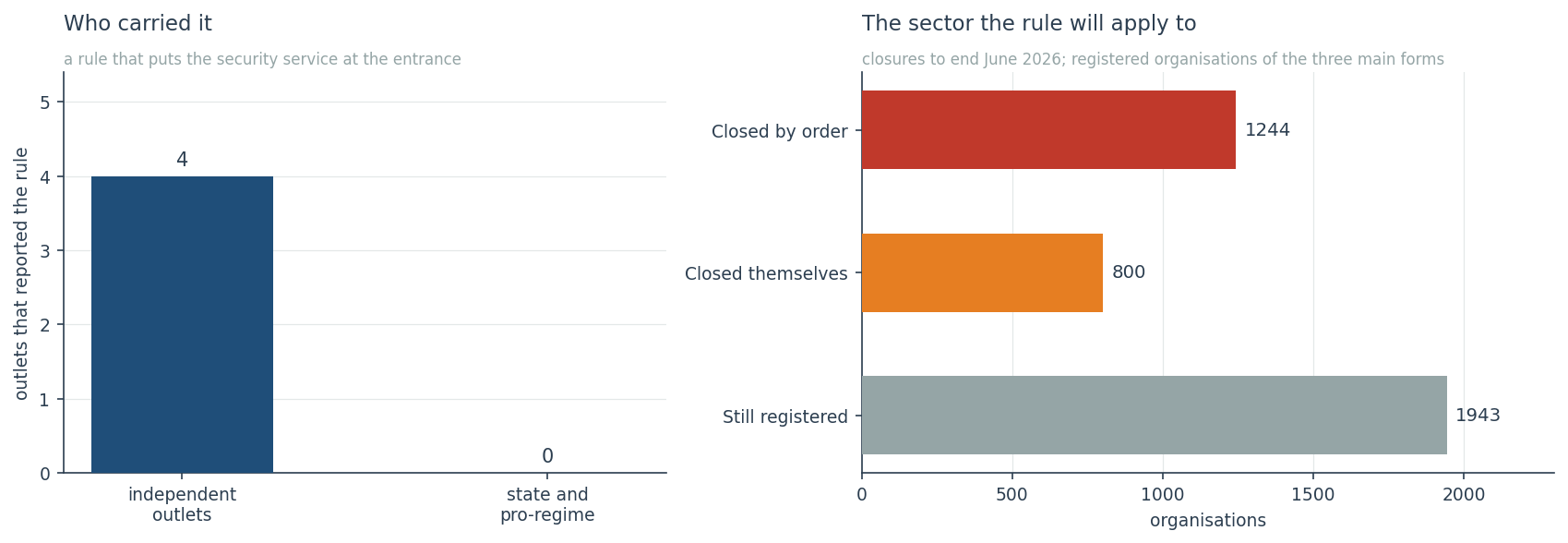
We counted the other end of this on 28 August. By the end of June 2026, Lawtrend’s register held 2,044 closed organisations: 1,244 that the state shut by order and 800 that resolved to dissolve themselves. In the quarter to June, for the first time, more closed themselves than the state closed.
Against that stands the sector as it is now: about 1,943 non-commercial organisations of the three main legal forms remain on the register.
So the shape of the last six years is a sector reduced by roughly half its own size again, mostly through orders, lately through exhaustion. The new rule addresses what is left of the other direction. Nobody needs to refuse a registration if the security service checks the applicants first.
Two thousand and forty-four closed. Now the entrance.
What the rule does
The reporting is thin but consistent. DW, citing Viasna, wrote on 25 August that a check of the founders by the KGB becomes a compulsory stage of registration from 1 July 2027, for natural and legal persons alike, and for associations and unions. Euroradio reported the same day that new civic initiatives will be cleared by the security service from 2027. CityDog explained the procedure on 29 August. Reform named the act on 6 September, inside Viasna’s monthly review.
Two features are worth separating.
The check is of people. A registration refusal normally rests on the documents: the charter, the name, the address, the founding meeting. A check of founders rests on who they are, and it comes before anyone reads the documents.
And the lead time is long. The act dates from 1 June 2026 and takes effect thirteen months later. None of the reporting explains why, and we will not guess.
Four outlets carried it. The state press did not mention it once.
The case for the other reading
There is an argument that this changes less than it appears, and it deserves stating.
Registration in Belarus has not been a neutral procedure for years. Refusals have been common, grounds have been elastic, and applicants have long assumed that the security services had a view. On that reading, the 2027 rule writes down what already happened, and writing it down is more honest than the alternative.
That argument is reasonable, and it points at the real change. An informal practice can be denied, varied or quietly dropped. A stage in a procedure cannot. After July 2027 nothing remains to appeal against and nobody remains to blame: the refusal will be lawful, procedural and final.
An informal practice can be dropped. A stage in a procedure cannot.
The check is of people, not of papers.
Nobody told the public
Our corpus for June to September holds four independent outlets on this rule and nothing at all from state or pro-regime sources.
This changes who may found an organisation in Belarus. The state press covers registration rules, charity campaigns and volunteer awards in detail, and it has not mentioned this at all. As with the transfers of farms we wrote about on 3 September, the silence is not inattention to the subject. It is silence about one part of it.
Confidence
Watch
Someone publishes or quotes the act in full, with the list of legal forms and the time limit for the check.
A state outlet describes the rule before it takes effect in July 2027.
The number of registered non-commercial organisations falls below 1,900 in the next official count.
Any organisation registers successfully after 1 July 2027 and says publicly how long the check took.
Method and limits
We have not seen the act. Everything here about its content comes from four reports and from Viasna’s monthly review, which is their common source. The two dates, 1 June 2026 and 1 July 2027, are as those reports give them.
The closure figures are Lawtrend’s, which states them as minima. We published them here on 28 August. The count of registered organisations is from Lawtrend’s December 2025 monitoring and covers the three main legal forms.