
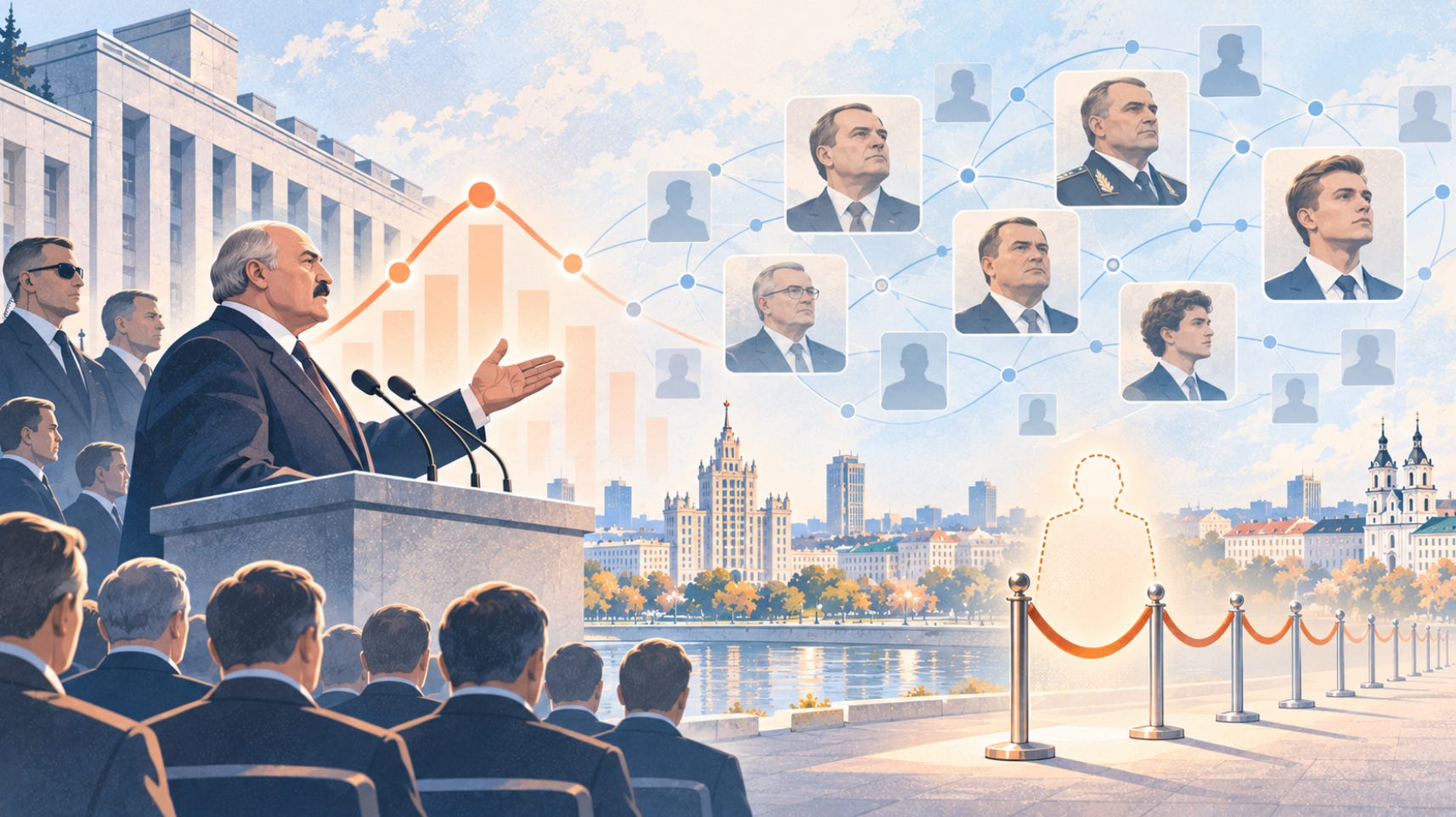
In October, Polish analysts and Polish television asked who will run Belarus after Lukashenko. In Belarusian state outlets the question has one speaker: since 2020, 63 of 97 state and pro-government headlines on succession carry Lukashenko’s own words.
In October three outside voices asked who comes after Lukashenko. Poland’s Centre for Eastern Studies (OSW) published a commentary on succession, TVP World’s Eastern Express built an episode on the Centre for New Ideas (CNI) map of 271 officials, and Yury Drakakhrust named Prime Minister Alexander Turchin on Belsat. Belarusian state and independent outlets treat the question very differently, and they show different people. What we cannot see is who actually matters: a count of mentions measures exposure, not power.
The question has one speaker
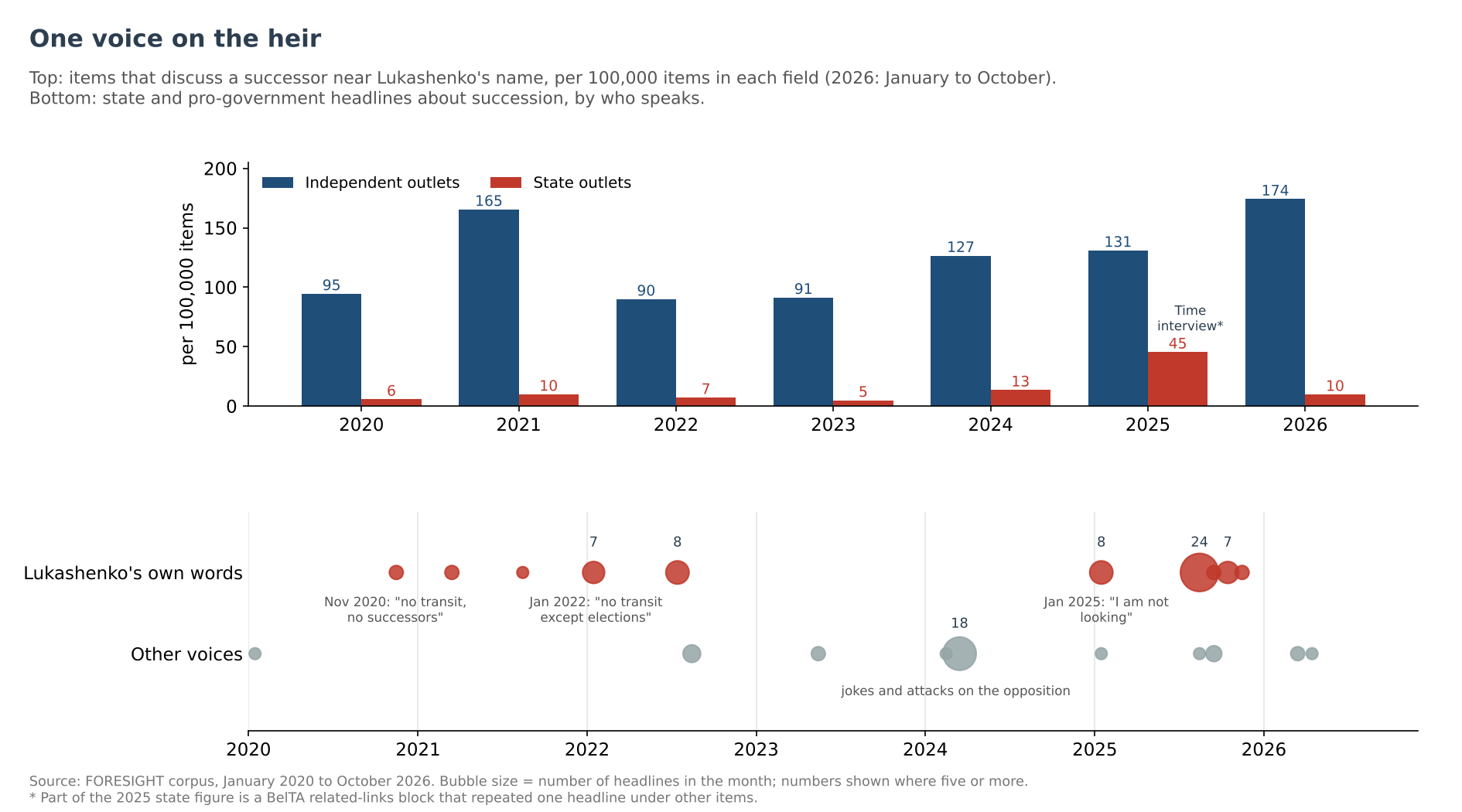
Since 2020, state outlets and pro-government Telegram channels in our collection have put “successor” or “transit” into 97 headlines about power in Belarus. Lukashenko’s own words fill 63 of them, from nine occasions. In November 2020 the headline was “No transit of power, no successors”. In January 2022 he said, “for the thousand and first time”, that he recognised no transit except elections. In July 2022, on a trip to the Slutsk district, he said “we are not eternal” and that the country needed two or three people ready behind him.
In January 2025 he was asked whether a successor was being sought. “I am not looking for this successor,” he answered. “Whether Natalya Ivanovna or Vladimir Yevgenyevich are looking, I do not know.” BelTA explained the names: Natalya Kochanova, who chairs the upper house, and Vladimir Kukharev. In August 2025 his interview with Time produced 24 headlines in one month. One of them said he had ruled out his youngest son Nikolai.
The other 34 headlines come from eleven occasions, and few of them are a debate. Four came within about two weeks after he had spoken, including two loyalists who explained that the choice is his. In 2022 the party leader Oleg Gaidukevich said that “Lukashenko thinks every day about tomorrow”. In 2025 the presenter Igor Tur said the successor “must be chosen by him himself”. Most of the rest were jokes or attacks. In March 2024 four outlets asked whether a baby he once held, now a hockey player, was a “successor”, and pro-government channels mocked the opposition three times for discussing the subject. This year the state field has run two such headlines, neither in his voice. One was an SB Telegram teaser that asked, in Belarusian, whether a son can succeed him, answered “it can, see the Constitution” and added a laughing emoji. The other was a YouTube video.
Independent outlets keep the question open. We counted items that mention a successor within 200 characters of Lukashenko’s name. Independent outlets ran between 90 and 174 such items per 100,000 every year since 2020, and 174 this year. State outlets ran between 5 and 14, except in 2025. That year the Time interview, and a BelTA block of related links that repeated its headline under other stories, lifted the state figure to 45. This year it is 10. Per item, independent outlets discuss a successor 18 times as often.
Two sets of names
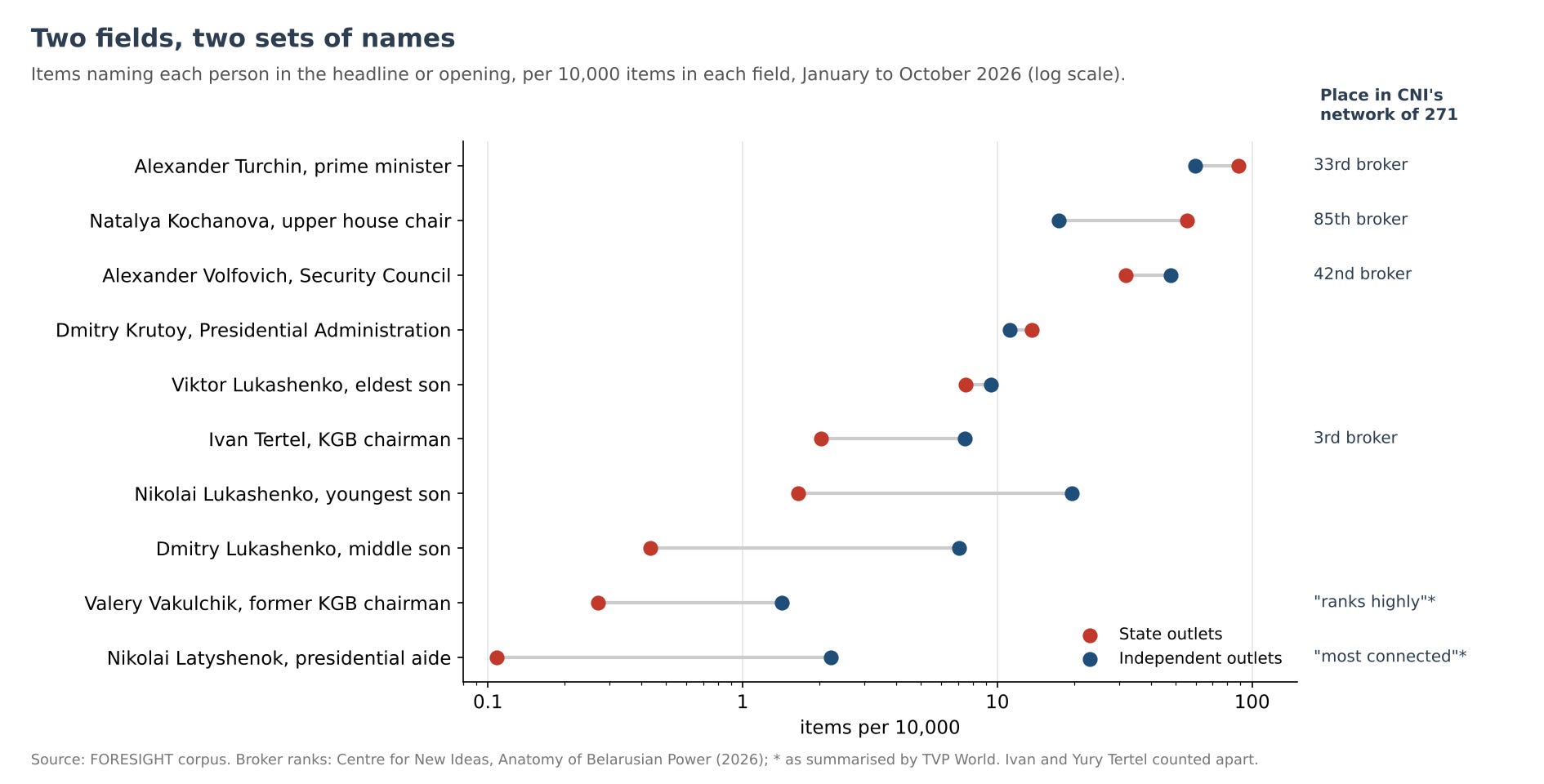
The fields also show different people. We counted items that name each possible heir in the headline or the opening. State outlets name Alexander Turchin, prime minister since 10 March 2025, in 88 of every 10,000 items this year, and Kochanova in 55. Alexander Volfovich, State Secretary of the Security Council, has 32, and Dmitry Krutoy, head of the Presidential Administration, has 14. Lukashenko’s sons are rare in state outlets: Viktor has 7.5, Nikolai 1.7 and Dmitry 0.4.
Per item, independent outlets discuss a successor 18 times as often.
Independent outlets change the order below the top. They name Volfovich far more often than Kochanova, 48 against 17, and Nikolai slightly more often than Kochanova, 20 against 17. Their attention to Volfovich has doubled since 2025, from 24 to 48 per 10,000, while the state figure stayed at 32. Per item, they name Nikolai 12 times as often as state outlets do, and Dmitry 16 times as often.
The people the CNI map puts at the centre are the hardest to find. In that network, KGB chairman Ivan Tertel is the third-strongest broker, the person who most often links groups that are otherwise apart. State outlets named him in two of every 10,000 items this year. Nikolai Latyshenok, a presidential aide whom TVP World’s summary calls the most connected person in the study, appeared in four state items in ten months. Kochanova, only 85th as a broker, is the second most visible name. TVP World noted that some brokers are “relatively unknown publicly”. In state outlets, that is close to complete.
Kochanova’s own share has fallen, from 153 per 10,000 state items in 2024 to 55 this year. The parliament was elected in 2024, so we do not read this as a signal.
One swallow
Drakakhrust named two signs for Turchin, his part in the talks with the United States and his visit to a military range, and both appear in state texts as routine. On 22 October state outlets listed Turchin first among the officials present when Lukashenko received a report on the talks with the US. On 28 October BelTA reported that he would be shown new weapons at an air force and air defence range. No state item called him a successor.
The people the CNI map puts at the centre are the hardest to find.
His share of state items in October was 98 per 10,000, which is inside his range for the year of 49 to 122. It jumped from 12 to 113 when he became prime minister in March 2025, and it has stayed between 35 and 134 a month since. We did not count his predecessor, so we cannot say whether this is more than the post brings.
Three independent items called him a possible successor in October. All appeared on 29 and 30 October, and all were built on Drakakhrust’s comment: Charter 97, UDF and Gazeta.by. Drakakhrust himself warned that one swallow does not make a spring. “Today you are a successor, and tomorrow you may not be,” he added.
What the studies say, and who repeats them
The CNI map, which we reviewed in September, found 17 “super-brokers” and a network that holds together when single people leave it. Removing the 20 most important people shrinks its largest connected part by only 9%. BIPART found in June that no single official is the “second person” in the state, Krutoy included, as we noted in our review of that study. OSW, as TVP World summarised it, argues that none of the sons holds an office that would give him a firm base. Each describes a system that outlasts one man.
No state item called him a successor.
State outlets did not report the CNI map. At least 13 independent items covered it in September, among them Zerkalo and UDF, and no state item did. They did not report BIPART either, yet they read the same sources when it suits them. In August BelTA cited OSW in a story about Latvia and the border, and it quoted TVP World on Nord Stream. On succession they quoted neither.
Each describes a system that outlasts one man.
How sure we are
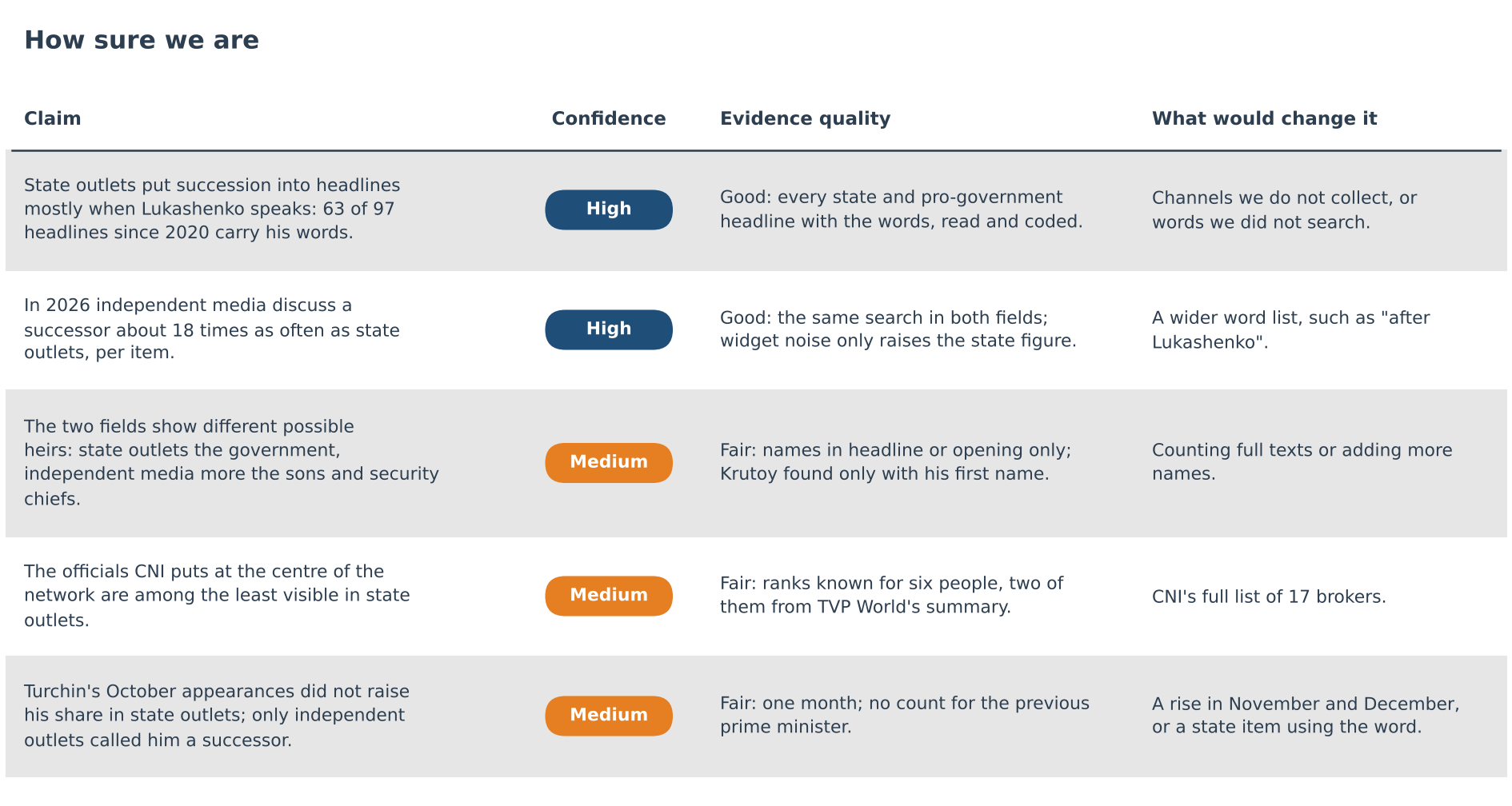
State outlets put succession into headlines mostly when Lukashenko speaks: 63 of 97 headlines since 2020 carry his words. High. Good evidence: every state and pro-government headline with the words, read and coded. What would change it: channels we do not collect, or words we did not search.
In 2026 independent media discuss a successor about 18 times as often as state outlets, per item. High. Good evidence: the same search in both fields; widget noise only raises the state figure. What would change it: a wider word list, such as “after Lukashenko”.
The two fields show different possible heirs: state outlets the government, independent media more the sons and security chiefs. Medium. Fair evidence: names in the headline or opening only; Krutoy found only with his first name. What would change it: counting full texts or adding more names.
The officials CNI puts at the centre of the network are among the least visible in state outlets. Medium. Fair evidence: ranks known for six people, two of them from TVP World’s summary. What would change it: CNI’s full list of 17 brokers.
Turchin’s October appearances did not raise his share in state outlets; only independent outlets called him a successor. Medium. Fair evidence: one month; no count for the previous prime minister. What would change it: a rise in November and December, or a state item using the word.
How it fits
How it fits. In the state field, succession is a subject that one man opens and closes. Others speak after him, joke about it, or attack those who raise it. Outside, OSW, CNI and TVP World look at a system that would outlast him, and the independent field names more of the people in it. None of the seven theses in our working model covers this, so we record it as an observation. It touches T6 from the other side: here the one-man frame belongs to state outlets, not to European observers. The simpler reading is that state editors never guess about the future of the head of state, on any subject, and succession is no exception. On that reading the pattern tells us about editing rules, not about succession. The test: if a state outlet discusses a successor without a statement from Lukashenko to follow, the pattern weakens.
What to watch
By 31 December 2026, after the third session of the All-Belarusian People’s Assembly on 17 and 18 December (who sits in it), a state or pro-government headline links the session to a successor or a transit. We expect none, with Medium confidence.
By 31 March 2027, a state or pro-government headline calls Alexander Turchin a possible successor. We expect it does not, with High confidence.
By 30 June 2027, a state headline shows someone other than Lukashenko discussing who might succeed him, outside the two weeks after a statement of his, and not as a joke. We expect none, with Medium confidence.
Method and limits
We used the FORESIGHT corpus from January 2020 to 31 October 2026. Talk of succession counts items with “successor” or “transit of power”, in Russian, Belarusian or English, within 200 characters of Lukashenko’s name, leaving out digests and CTV pages. We read and coded all 112 state and pro-government headlines with these words. Fifteen were not about power in Belarus, such as a constitution described as the “successor” of the Soviet one. An occasion groups the headlines of one speaker within three days. Names were counted in the headline and the first 2,500 characters, so the measure is prominence, not every mention. Ivan Tertel and his brother Yury were counted apart, and Krutoy was found only with his first name, because his surname is also a common Russian adjective. Rates use all items of each field in the same months. Broker ranks come from CNI’s report through our September review, except for Latyshenok and Vakulchik, where we rely on TVP World’s summary. We describe OSW’s commentary as TVP World summarised it, because the OSW site refused automated access. Quotations from Russian are our translation. Thesis tag: none (observation; it touches T6).