
On 19 October 1996, 4,740 delegates met in the Minsk Palace of Sports for the first All-Belarusian People’s Assembly. Since the 2022 constitutional changes, the assembly is a permanent body whose decisions are binding, and its third session is set for 17–18 December. We read the official list of elected delegates and coded the jobs of 625 of the 750 elected members. We do not know who owns the 49 joint-stock companies that employ some of them, and 65 youth-union delegates are missing from our copy of the list.
A seat for the people
Daniel D. Jacques, a philosopher from Quebec, published Leçons de démocratie this year (Boréal, 2026). The book never mentions Belarus, but one of its lessons fits the country closely. In a modern democracy, Jacques writes, the sovereign people has no voice and no body of its own. Someone has to speak for it: the rebel at the barricade, the autocrat at the rostrum, the deputy in the chamber or the judge in court. In his reading of the modern tradition, only “the people assembled” can claim the right to command.
Belarus has answered this question in a very literal way. In 2020 the opposition tried to count the people, through a voting platform and photographed protocols. The state chose to assemble it instead. It wrote the assembly into the constitution, and its own press pool now calls it “Belarus in miniature”. The same post points out that the first assembly could only make recommendations, while today’s decisions must be carried out. So the useful question is a simple one. Who is in the room?
Four ways in
The law allows 1,200 seats. In April 2024 the prime minister reported 1,162 delegates, and the sessions since then have registered between 1,137 and 1,159.
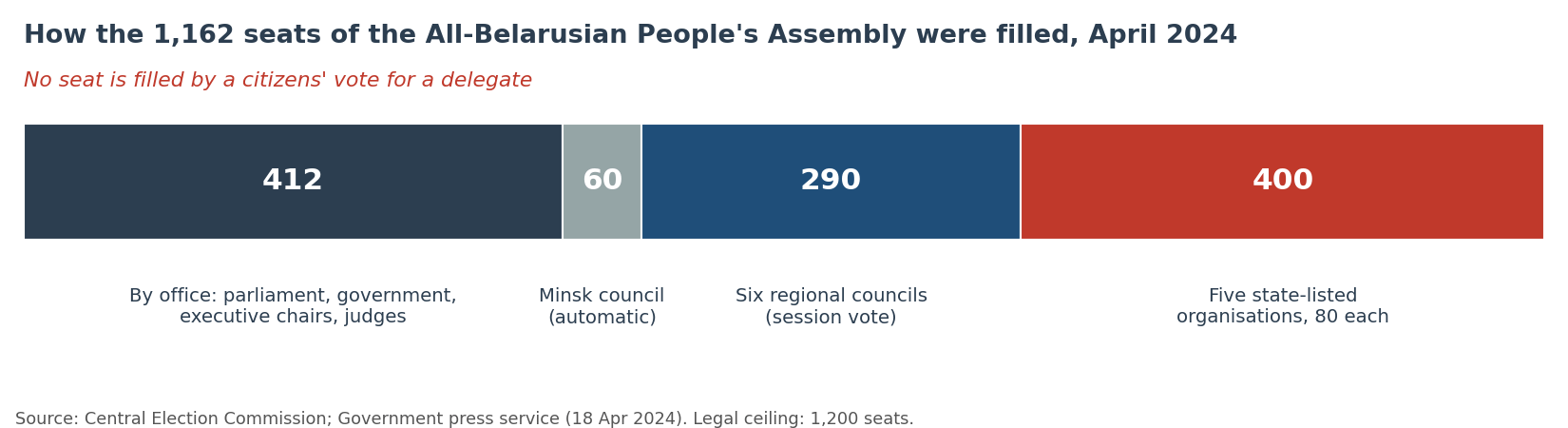
Of the 1,162, 412 sit by office. They include the head of state, both chambers of parliament and the government. The chairs of regional and district executive committees and the judges of the two top courts also sit by office (CIK guidance). All 60 deputies of the Minsk city council join automatically. The six regional councils elected another 290 at their sessions (Council of the Republic). The last 400 seats belong to “civil society”. State media have long used that phrase in a sense of their own, as we measured in A Tenth of a Point.
Only organisations that pass a legal filter can fill those 400 seats. A public association needs at least 100,000 adult members and branches in every region and in Minsk. A trade-union body must unite at least half of all registered unions. At the start of 2024 Belarus had 1,973 registered public associations. The Ministry of Justice then draws up the list of those that qualify. In 2024 it held five names. Four were associations: Belaya Rus, the veterans’ association, the Women’s Union and the youth union BRSM. The fifth was the Federation of Trade Unions (FPB). Each got 80 seats. New organisations face a filter of their own: from July 2027 the KGB will check their founders (Who May Start One).
None of these four routes is a vote by citizens for a delegate. Members of parliament and Minsk deputies did face voters in February 2024, but they were elected to other bodies.
In the coded quota, more than half of the working delegates run an organisation or are deputy heads.
The list nobody could search
The Central Election Commission published the full list of elected delegates in the state daily SB on 19 April 2024. The list was printed as images, so it does not appear in text searches. We read the images with text-recognition software and coded each delegate’s job in two ways. The first is the role: head, deputy head, head of a unit or rank-and-file. The second is the type of employer. Our copy covers all 290 regional-council delegates and 335 of the 400 civil-society delegates.
In the civil-society quota, 59 delegates are listed as pensioners, and 56 of them come from the veterans’ association. Of the 276 who work, 57% run an organisation or are deputy heads. In total, 79% work in the state sector. This means state bodies, state institutions, unitary enterprises, state media or the staff of the five organisations themselves. Another 18% work in joint-stock companies, and many of these have large state stakes. Only nine delegates work in private firms, cooperatives, a church or a charity.
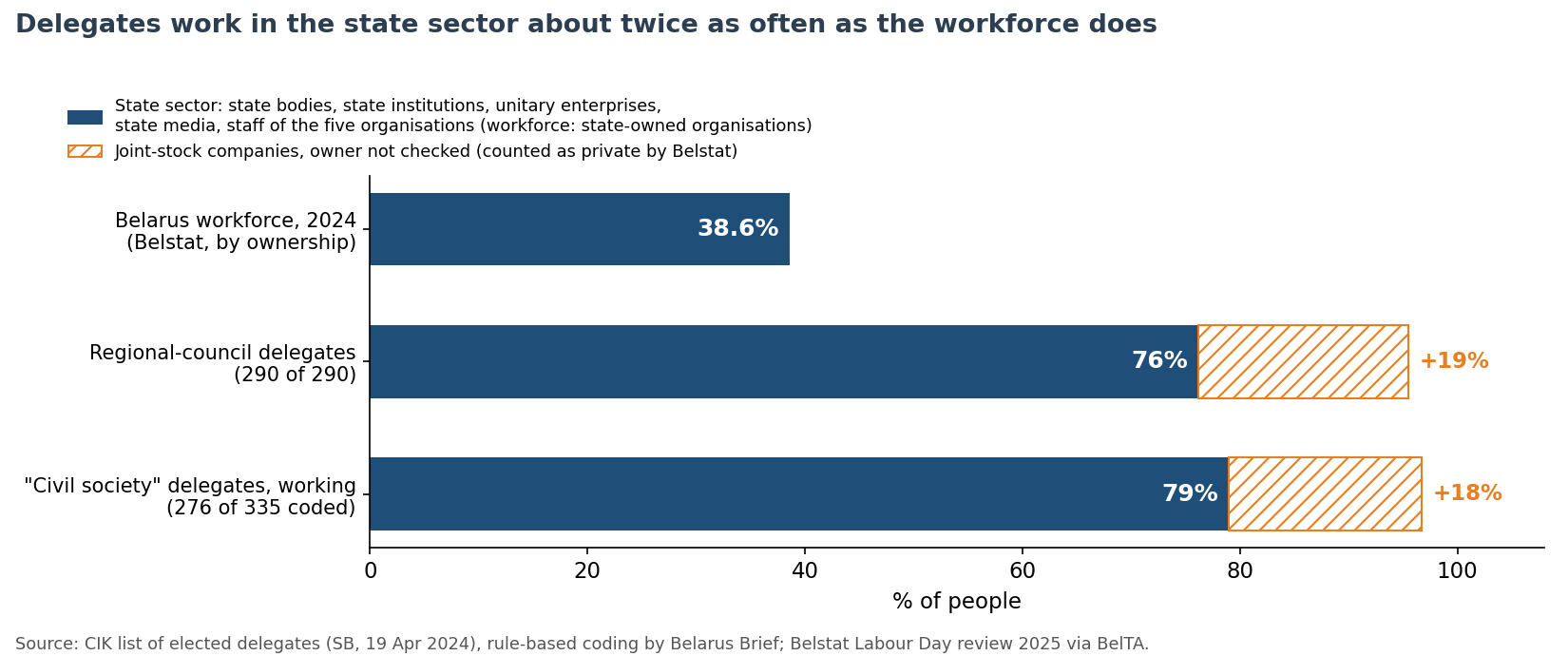
These shares need a benchmark. According to Belstat, 38.6% of employed Belarusians worked in state-owned organisations in 2024 (BelTA report via Mail.ru). The civil-society quota is about twice as concentrated in the state sector as the workforce it is meant to represent. Belstat counts companies with state stakes as private, so the true gap may be wider.
The quota also has rank-and-file members, and they should not be written out of the picture. More than a third of the working delegates are nurses, teachers, tractor drivers, machine operators or engineers. That share is higher than among regional-council delegates, where it is 19%. The quota mixes ordinary state-sector workers with the top of the state.
The Ministry of Justice draws up the list of civil society, and in 2024 it held five names.
The top of the state
Twenty delegates in the civil-society quota hold senior state posts. Ten of them work at national level. The trade unions sent Prosecutor General Andrei Shved, Yuri Nazarov, who runs the head of state’s property office, and Alexander Kosinets, an aide to Lukashenko. Belaya Rus sent National Bank chairman Pavel Kallaur. The Women’s Union sent Lukashenko’s press secretary Natalya Eismont and First Deputy Justice Minister Natalya Filippova. The veterans sent Alexander Volfovich, State Secretary of the Security Council, and Viktor Sheiman, Lukashenko’s special representative. They also sent two of his aides who act as inspectors in the regions, Valery Vakulchik and Yuri Karaev. How careers at this level are built is the subject of a September map of the Belarusian elite, which we reviewed in What a Personnel File Can See.
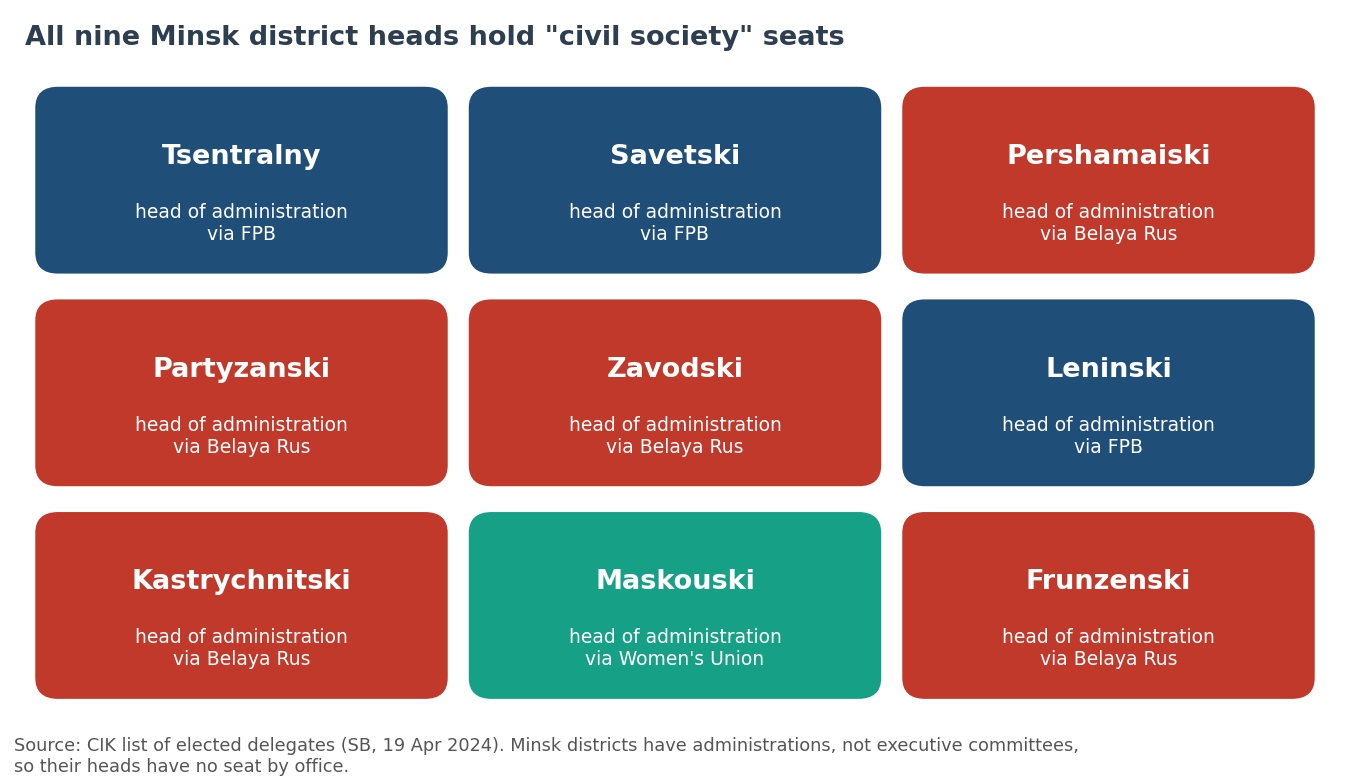
The other ten run Minsk: the first deputy chair of the city executive committee and the heads of all nine district administrations. By law, chairs of district executive committees sit by office. Minsk districts are run by administrations, which the law does not list, so their heads have no automatic seat. All nine came in as civil society. Five used Belaya Rus, three used the trade unions and one used the Women’s Union.
The Women’s Union also sent the heads of the ideology departments of the Vitebsk and Mogilev regional executive committees and of the Minsk city executive committee. A deputy head of the Grodno ideology department came in the same way.
All nine heads of Minsk district administrations entered the people’s assembly as civil society.
Seats that lead to posts
The assembly elects its own leaders and some of the state’s top officials. Several of them came through the civil-society quota. Kosinets, a trade-union delegate, was elected deputy chairman of the assembly on 24 April 2024. Shved, the Prosecutor General and also a trade-union delegate, was elected chairman of the Supreme Court by the assembly on 19 December 2025. On the same day the assembly elected Sergei Sivets, a member of its presidium, chairman of the Constitutional Court. Promotion inside the apparatus was the subject of our two-part series on careers in a dictatorship (What the Apparatus Is Owed, Where They Went).
The quota can also be refilled at short notice. On 12 December 2025 the trade-union federation held an extraordinary congress to replace two delegates who had left. It elected Dmitry Krutoy, head of Lukashenko’s administration, and Roman Golovchenko, chairman of the National Bank (BelTA). In 2024 Golovchenko had sat in the assembly by office, as prime minister. The election commission confirmed the result on 15 December, and the session opened three days later. In both sessions the head of the central bank sat in a civil-society seat, first through Belaya Rus and then through the trade unions.
There is an official explanation for this mix. In 2024 officials described the five as the country’s leading associations, and the assembly as a cross-section of the whole society. Our coding shows that the sectors are indeed present. They are represented mostly by managers, and mostly from the state sector.
The head of the central bank sat in a civil-society seat at both sessions, first through Belaya Rus and then through the trade unions.
Between sessions
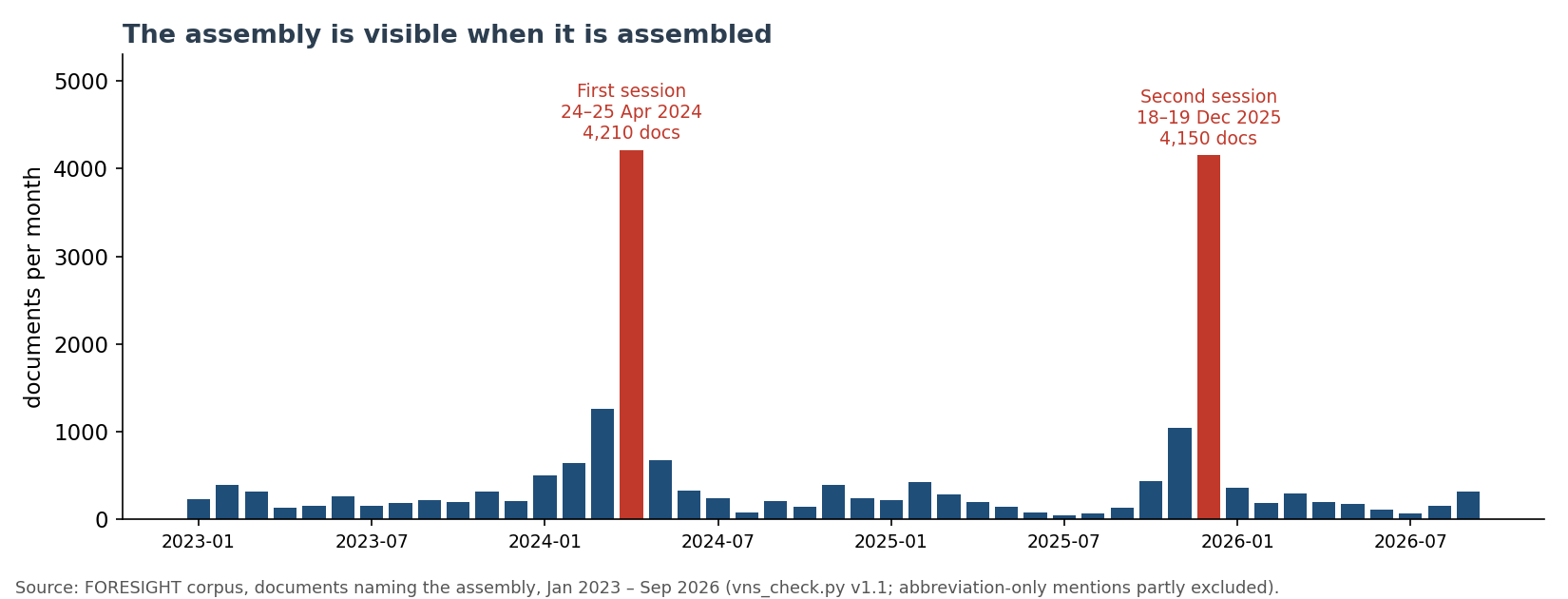
The assembly is rarely in the news when it is not sitting. Our corpus holds 20,907 documents since January 2023 that name it. Of these, 40% appeared in just two months, April 2024 and December 2025. In summer 2025 the count fell to between 43 and 85 documents a month.
How it fits
Observation: the quota that brings “civil society” into the people’s assembly is also the entry for senior officials who have no seat by office. None of the seven theses in our working model covers it, so we record it as an observation, not as a test. The alternative is that the five organisations are built around workplaces, and the state employs many Belarusians, so a state-heavy quota may simply mirror who the members are. Two things separate these readings. The quota’s state share is twice the workforce share, and a random draw of members would not produce a prosecutor general or all nine Minsk district heads. A published breakdown of each organisation’s membership by employer would test the alternative directly.
What we expect
We will score these after the session, as we scored our third-quarter forecasts in A Ledger of Questions.
On 17–18 December 2026, fewer than 1,137 delegates will register, the number registered in December 2025. Confidence: Medium.
Before that session, at least one civil-society seat will be refilled “instead of a departed delegate”, and a sitting senior official will take it. Confidence: Low.
Documents naming the assembly will exceed 3,000 in December 2026 and fall below 300 in February 2027. Confidence: Medium.
If the December session elects judges or other officials, at least one of them will be a sitting delegate. Confidence: Low.
Confidence
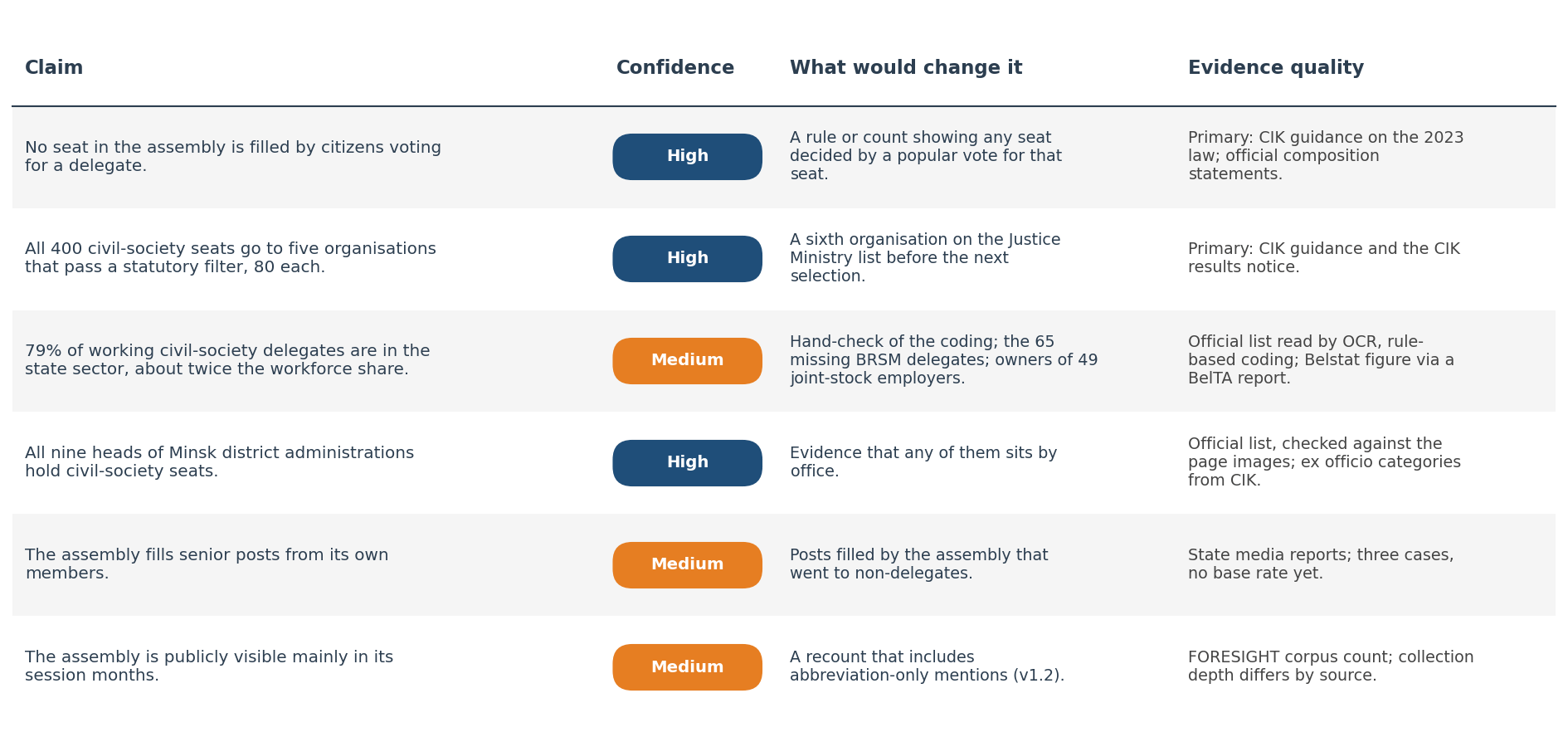
The rules and the composition come from primary documents, so those claims are strong. The coding rests on a list read by software and coded by rules. We checked every name in the senior-official group against the page images, but not every one of the 625 rows.
Method and limits
The list of elected delegates is the CIK list printed by SB on 19 April 2024, read with Tesseract OCR. The first 34 Brest delegates come from an earlier SB text, which gives names without birth dates. Two merged rows were split by hand and four birth dates were corrected from the images. Rows 6–70 of the BRSM list were not available to us. The 412 delegates by office and the 60 Minsk deputies are not in the list. Jobs are those listed in April 2024. Each job was coded by fixed rules for role and employer type, and the codebook is available on request. We did not check who owns the 49 joint-stock companies. The Belstat benchmark comes from a BelTA report, and Belstat counts companies with state stakes as private. Document counts come from the FORESIGHT corpus, where collection depth differs by source.