
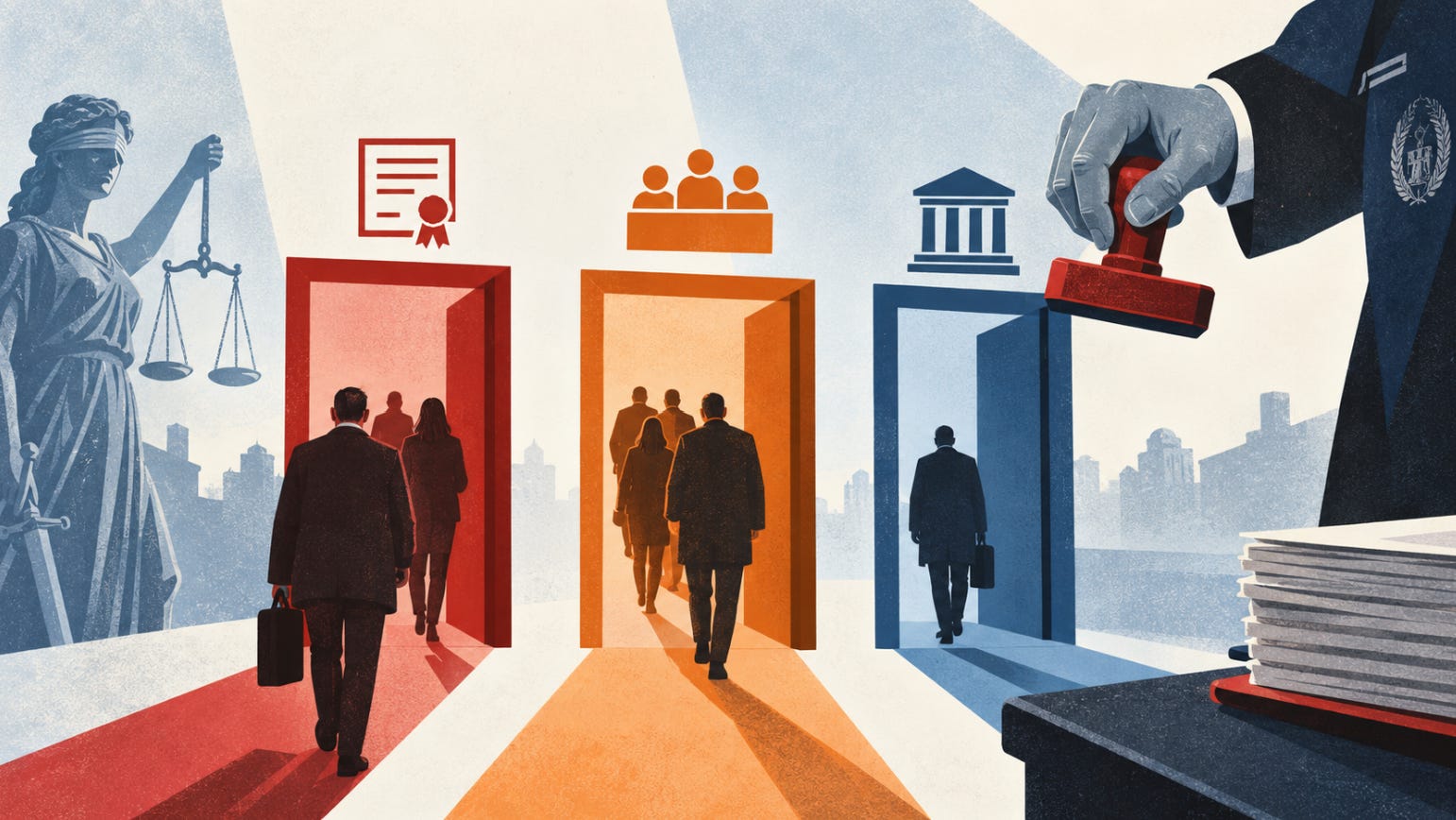
September 9, 2026 a Belarusian court sentenced Dmitry Laieuski, once the lawyer for Viktar Babaryka, to three years for giving interviews to independent media. He had lost the right to practise years ago — not by a ministerial order, but by a vote of his own bar association’s disciplinary body. That route accounts for a third of all the lawyers pushed out of the profession since 2020. The ministry itself withdrew only nineteen licences.

Three doors, one outcome
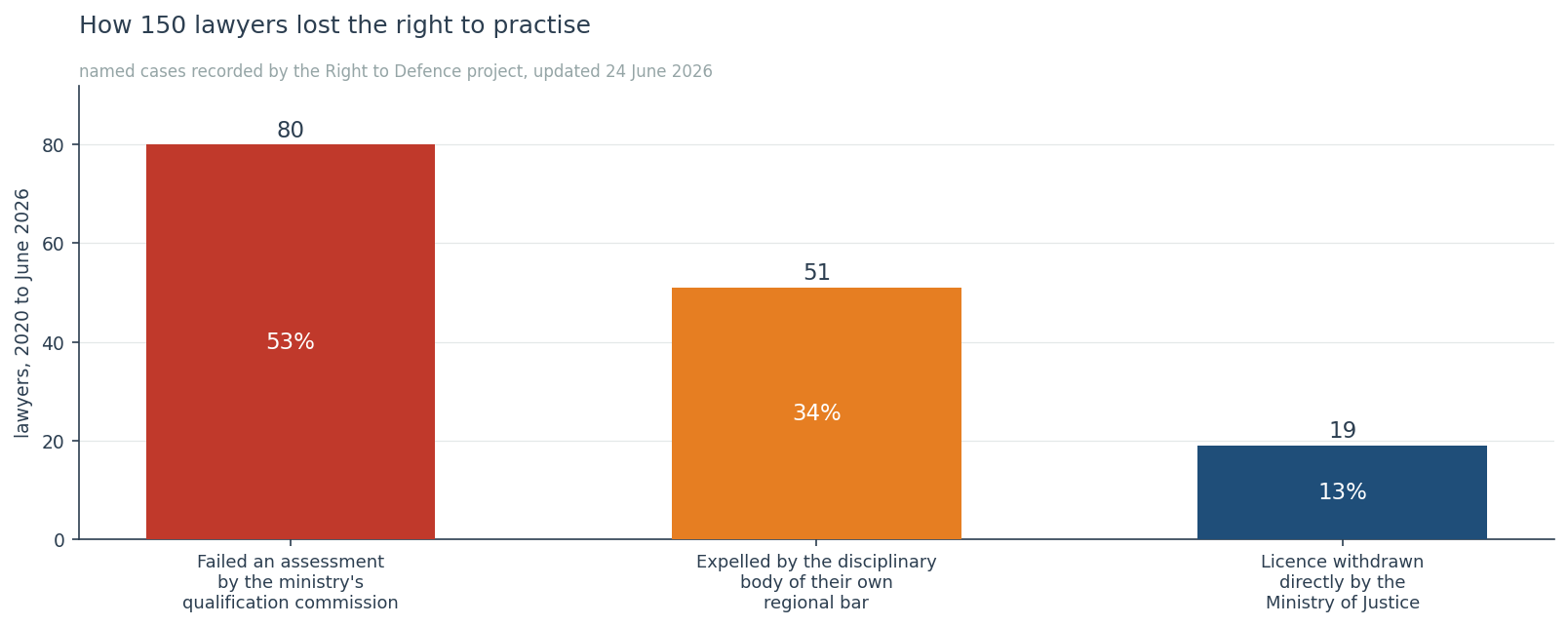
The Right to Defence project keeps a named register of persecuted Belarusian lawyers, updated on 24 June 2026. It separates them by the mechanism used, and the separation is the story.
Eighty lawyers, 53% of the total, were found unfit at an assessment by the qualification commission attached to the Ministry of Justice. Fifty-one, 34%, were expelled by the disciplinary bodies of their own regional bar associations. Nineteen, 13%, had their licences withdrawn directly by the ministry for “conduct incompatible with the title of advocate”.
Together that is 150 people who can no longer work as lawyers. A further sixteen face criminal prosecution, and the register counts 155 individuals in all.
The attestation route deserves a note. It used to be a routine check every five years. The rules now allow the commission to summon any lawyer at any time, outside the schedule. A procedure designed to confirm competence became the main instrument for removing people.
The ministry signed nineteen orders. The other 131 left by other doors.
What the overlaps show
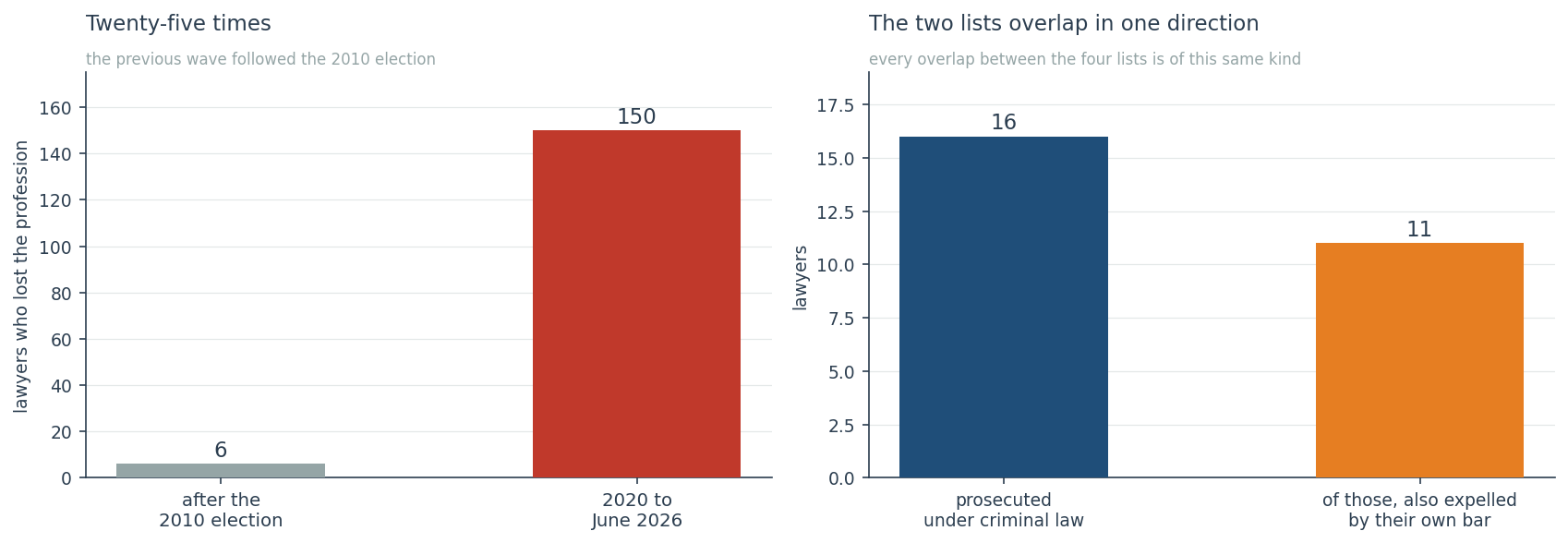
Eleven names appear on two of the register’s lists, and every one of those overlaps is the same pair: a lawyer facing criminal prosecution who was also expelled by the disciplinary body of their own bar.
Of the sixteen lawyers under criminal prosecution, eleven were expelled by colleagues. None of the sixteen lost a licence by ministerial order.
That pattern is worth stating carefully. It does not show that bar associations acted freely. Belarusian law has steadily placed the collegiums and their disciplinary bodies under the direct supervision of the Ministry of Justice, and refusing to expel a colleague has itself cost lawyers their own status: one was removed after declining to vote out a colleague who took political cases.
What it does show is where the decisions were formally taken. On paper, the profession removed its own.
On paper, the profession removed its own.
The scale, against the last time
After the 2010 election, human rights monitors linked six licence withdrawals to political persecution. The current count is 150. Beyond them, Right to Defence estimates that roughly 300 more lawyers left the profession themselves under threat of prosecution, which is a figure of a different kind and not part of the named register.
The shape is familiar from our other work this month. More than 2,000 organisations closed, most of them lately by their own decision. Seven manor houses struck from a heritage register rather than demolished. Sentences extended inside colonies without a new crime. In each case the state avoids the act that would need a signature and a defendant.
A procedure meant to confirm competence became the main way of removing people.
One more thing about the register
The website that holds this register has itself been declared extremist material in Belarus. Its front page carries instructions on how to visit it safely.
So the document recording how lawyers were removed from the profession is illegal to read in the country where it happened. Anyone inside Belarus who opens it to check a name is committing an offence, and the lawyer they might have consulted about that is on the list.
The record of how lawyers were removed is illegal to read where it happened.
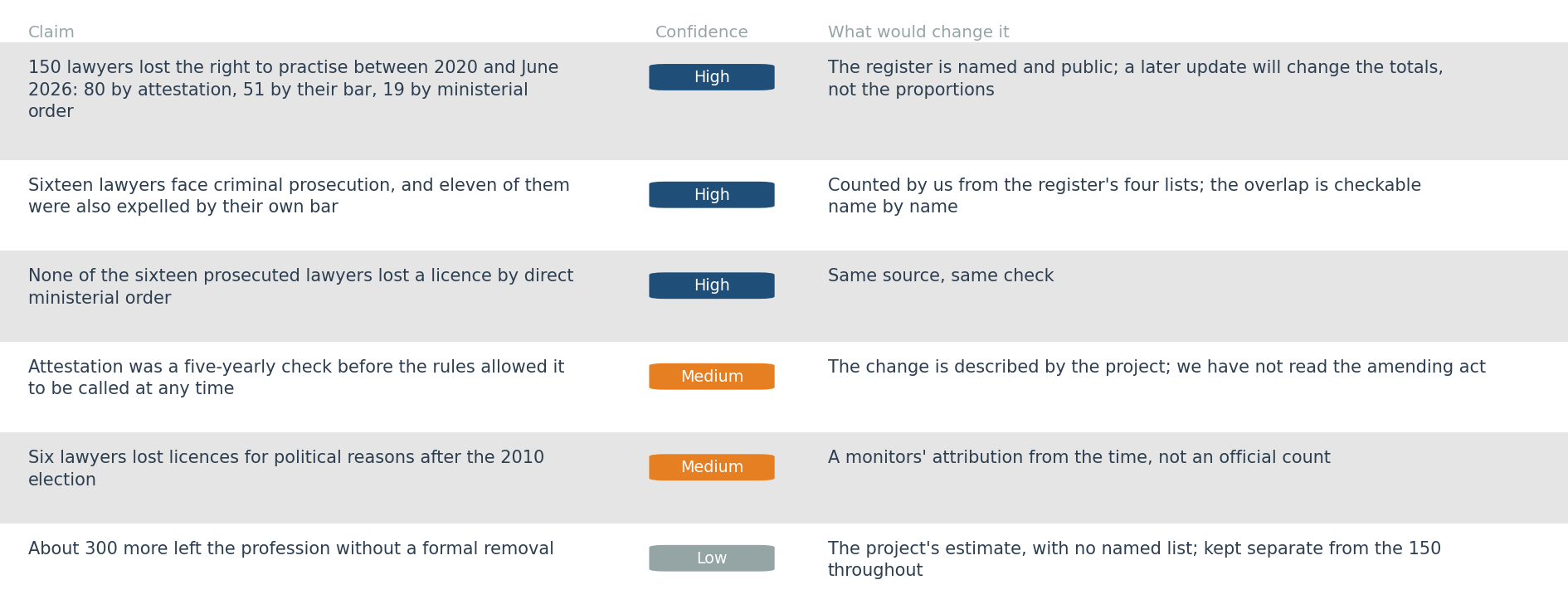
Confidence
Watch
The register passes 160 named lawyers before the end of the year. It stood at 155 in June.
Any lawyer removed by attestation is restored after an appeal. We know of none.
A regional bar association publicly refuses an expulsion demanded of it.
Laieuski’s sentence is reduced or overturned on appeal, or he joins a future release.
Method and limits
All counts come from the Right to Defence register as it stood on 24 June 2026: sixteen under criminal prosecution, nineteen stripped of a licence by the ministry, eighty removed through attestation, fifty-one expelled by their bar. We counted the unique names ourselves and found 155 individuals across the four lists, with eleven appearing twice.
The register is a project’s compilation from open sources and submissions, and it says so. It is a floor, not a census: its own page asks readers to write in about anyone missed.
The figure of roughly 300 lawyers who left the profession without a formal removal is the project’s estimate and is not a named list. We keep it separate from the 150 throughout.
We do not know what any individual disciplinary body was told or threatened with before it voted. The register records the formal route, and this piece follows it. That is a statement about procedure, not about the people who sat on those commissions.