

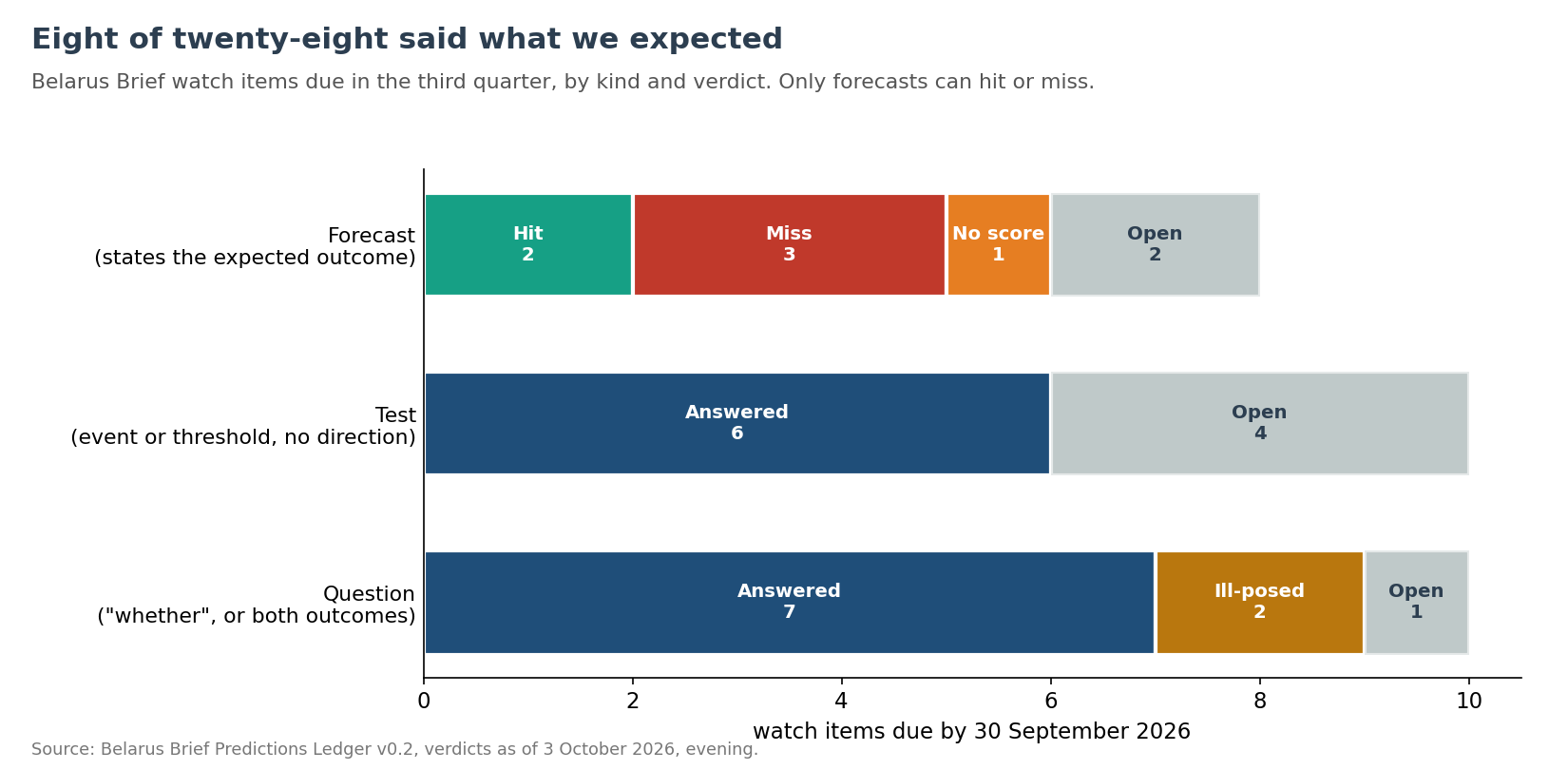
By 30 September 2026, 28 of the watch items published in Belarus Brief since July had reached their deadline. Only eight of them said which outcome we expected, and of the five we could score, two came true and three did not. The other twenty named an event or asked a question, so they have answers but no score, and two had deadlines before their data existed. What we cannot yet say is whether our forecasts are any good, because five scored forecasts are far too few to measure that.
Why we keep a ledger
Since July, most briefs have ended with dated watch items. In August we turned the published archive into a ledger, which now holds 260 items, and we promised a first score once the third quarter closed. We set two rules before looking at any result. We judge each item by its published wording, with no reinterpretation after the fact. And we publish a hit rate only when at least 20 forecasts have a verdict; until then we report counts.
Reading the items again, we found three kinds. A forecast says which outcome we expect. A test names an event or a threshold but no direction, as in “if it does, the reading changes”. A question asks “whether” something will happen, or offers both outcomes at once. Only a forecast can hit or miss, so only forecasts enter the score. For tests and questions, the ledger records the answer.
The eight forecasts
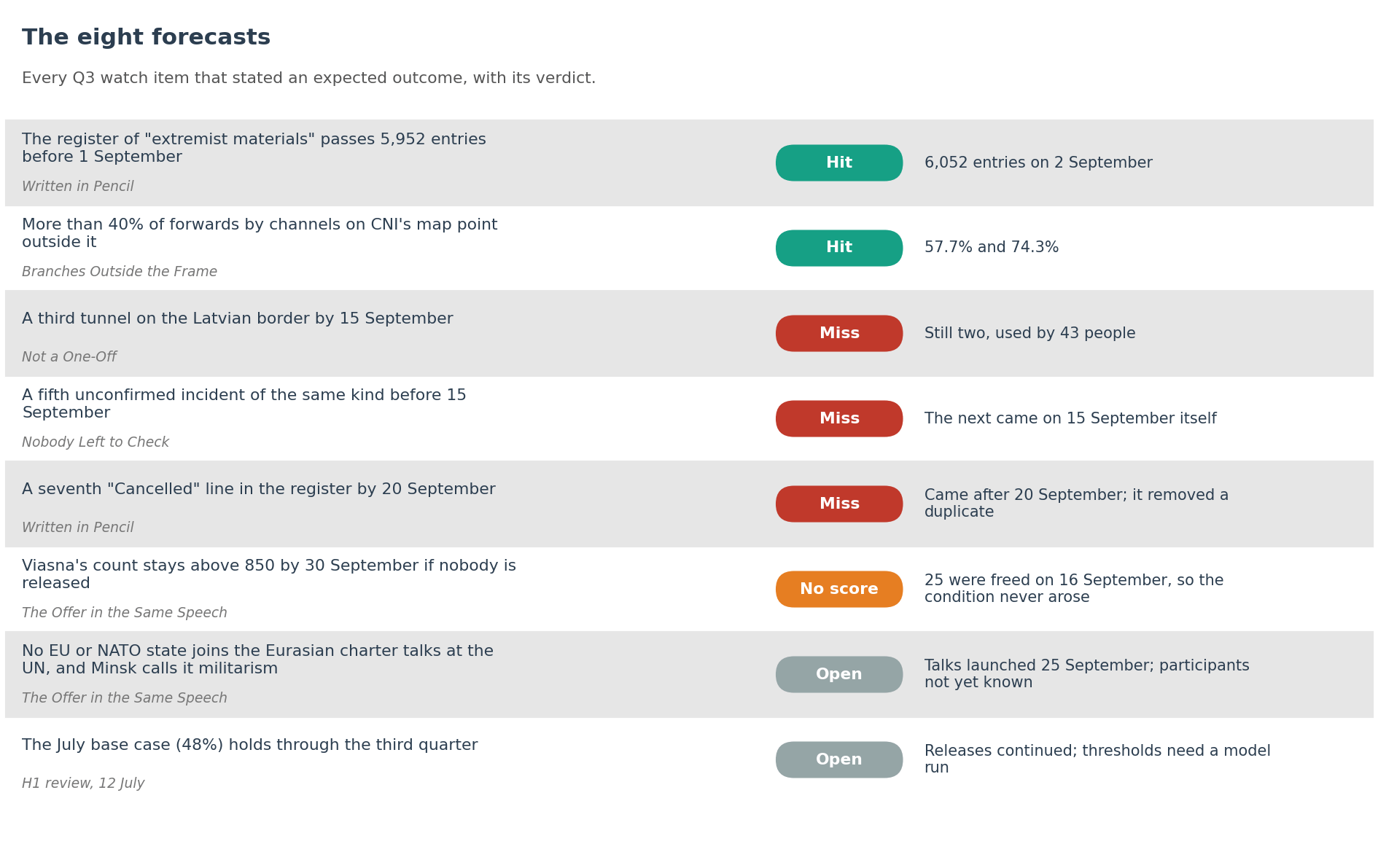
The two hits were both counts we could check ourselves. In “Written in Pencil” we expected the register of “extremist materials” to pass 5,952 entries before 1 September, and it held 6,052 when we read it on 2 September. In “Branches Outside the Frame” we expected more than 40% of the forwards made by channels on the Centre for New Ideas’ map to point outside it. The count, published on 2 October, was 57.7% and 74.3%.
Only eight of them said which outcome we expected.
The three misses were all about a rate. In “Not a One-Off” we expected a third tunnel on the Latvian border by 15 September, after two in eleven days. By mid-September there were still two, used by 43 people, Belsat reported from the border. The rate may have stopped, or Latvia may have found fewer tunnels than were dug. In September Latvia extended Operation Vilkatis, which put extra guards on the border, and our count cannot separate the two readings.
In “Nobody Left to Check” we expected a fifth unconfirmed incident of the same kind before 15 September. We found nothing new before that date. The next one came on the deadline itself, when a drone crossed from Belarus into Lithuania during the night of 14 to 15 September. Another object entered Lithuania from Belarus on 3 October, LRT reported, and the crisis centre said that it might have been a drone or a flock of birds. The pattern held, but our deadline did not, and the item counts as a miss.
In “Written in Pencil” we also expected a seventh “Cancelled” line in the register by 20 September, at a rate of roughly one every six months. It arrived in the two weeks after the deadline, and it removed a duplicate rather than a ban, as the section on the register explains.
Three forecasts have no score yet. In “The Offer in the Same Speech” we expected Viasna’s count of political prisoners to stay above 850 by 30 September if nobody was released. Twenty-five people were freed on 16 September, so the condition never arose. The same brief expected that no EU or NATO state would join talks on Minsk’s “Eurasian charter” at the UN, and that Minsk would call the refusal European militarism. The talks were launched on 25 September at Russia’s UN mission, and we have not yet established who took part.
The base case in our July review of the first half of the year, which we gave a probability of 48%, expected the releases to continue, and they did. It also set two thresholds for the language of state media, and only a new run of the same models can check them. Our collection has grown a lot since July, so we must measure both halves of the year on the same set of sources. Until then this forecast stays open.
The pattern held, but our deadline did not.
Tests and questions
Thirteen of the twenty tests and questions have answers. Latvia extended Operation Vilkatis to 3 October, the day of its election. Euronews and the Polish news agency PAP kept their usual volume in our collection after their websites were designated “extremist material”. Euronews had 22 documents in September, against an average of 16 from March to July, and PAP had seven, as in May to July. No state outlet reported a border tunnel in its own words between 23 August and 15 September. The Maladechna court’s run ended, with two designations in the third quarter after 16 in the second. The busiest single court in the quarter was the Leninski district court in Hrodna, with 50, as we reported yesterday in “Closing the Inbox” . The Babariko channel, which came back in August, published nothing in September, and only one video named both Babariko and Latushka, against 21 joint mentions in August.
Two of our items asked about data that did not yet exist. One set 20 August as the deadline for a currency figure that the National Bank publishes in September. Another set 30 September for trade data that comes out in November. We cannot judge either as written, and both count against our writing rather than against the world.
Five items are still open, and most of them have one thing in common. They depended on runs of our own data, such as a separate Google Trends query or a weekly series from July, which nobody scheduled when the item was written. A simpler reading is that some of them were set only weeks before their deadline. Either way, an unplanned check tends not to happen.
The Trends test also had a flaw in its design. A query for a single name scales its own peak to 100, so over one month almost any signal would pass a threshold of 20. A threshold that is met by construction tests nothing.
Two of our items asked about data that did not yet exist.
A correction
In “Nobody Left to Check”, published on 27 August, we described a claim about a reservist call-up as having nothing behind it at all. We also wrote that nobody could currently check a call-up. Both statements went too far. On 9 August the state broadcaster’s site reported a call-up of reservists for up to 60 days in a special-operations unit. On 1 September the defence ministry announced call-ups for territorial defence from 1 to 25 September. Neither report describes mobilisation, which was the heart of the claim. But the call-up part of the claim had an official basis that we missed. Our monitoring window for that piece began on 10 August, one day after the first report, which explains the gap without excusing it.
The register moved under us
Two of our scored items rest on the public register of “extremist materials”, and the register itself changed during the quarter. In “Written in Pencil” we described how 75 entries had their dates of effect moved to 17 August. In September those dates were quietly put back, and the entries ruled in late August now carry the same date for ruling and effect. Then, between 20 September and 3 October, the register replaced one entry with the single word “Cancelled”. It was the TikTok account of the youth group Maladaya Hramada, designated by a court in Bykhaw in November 2025, and it is the seventh such line in the register since 2008. The register gives no reason, but a court in Dzyarzhynsk had designated the same account two weeks earlier, and that entry stands. The likelier reading is that a duplicate was removed and the account is still banned. An appeal against the second ruling alone cannot be ruled out, but for the account the result is the same. Maladaya Hramada appears in seven standing entries since 2023, from a Telegram channel to the logo of its Facebook page.
The call-up part of the claim had an official basis that we missed.
What changes from now
From this quarter, every watch item names the outcome we expect and a check date after the data is due. We will also plan the measurement when we write the item. Forecasts will carry the same High, Medium or Low label as our confidence tables. Once 20 or more have verdicts, we can test whether High forecasts come true more often than Medium ones. It is the same question our audit of the Belarusian Yearbook is now putting to its authors.
How sure we are
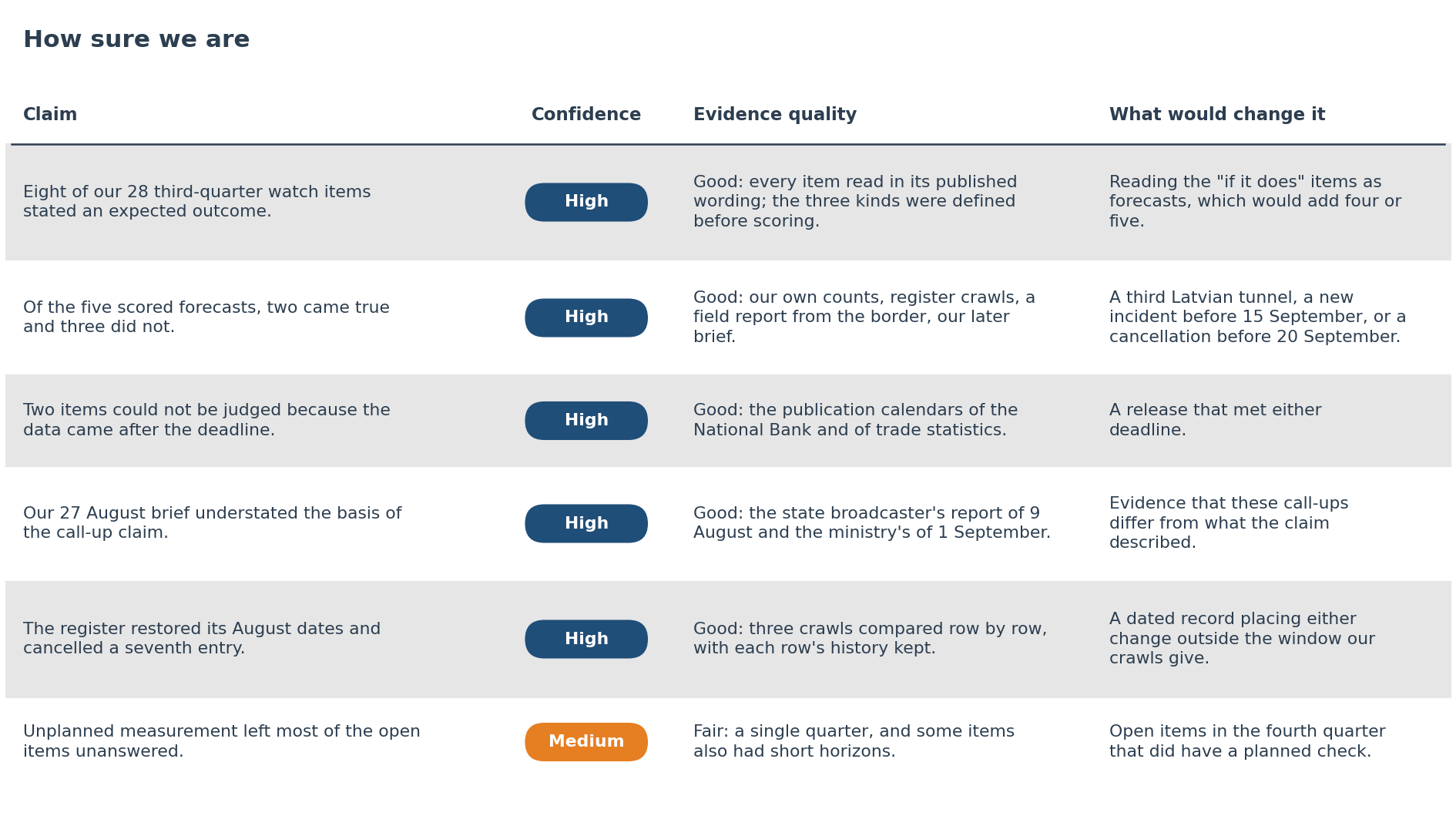
The counts in this brief are High, because each one rests on a source we can show. The Medium row is about why seven items stayed open, and one quarter cannot settle that.
What to watch
By 15 January 2027, more than 90% of the watch items we publish from 3 October to 31 December state an expected outcome. We expect this, with High confidence, because the rule now applies to every brief. The 49 older items that fall due in the fourth quarter were written before the rule, and we will report them apart.
By 15 January 2027, the Leninski district court in Hrodna is no longer the busiest single court in the fourth quarter. We expect its run to end, as the Maladechna run did, with Medium confidence.
By 31 October 2026, the July base case is scored on a new run of the same models over a fixed set of sources. We expect both of its thresholds for state language to hold, with Low confidence, since our only basis is that the release track also held.
By 31 December 2026, the register shows an eighth “Cancelled” entry. We expect one, with Medium confidence: the seventh removed a duplicate, and the register still lists at least two items twice.
Method and limits
The ledger was rebuilt from our Substack archive on 3 October 2026: 77 posts and 260 watch items, each kept in its published wording. Two items that the first version of the ledger had dated to December were in fact due in September; we found them while preparing this brief and added them to the quarter. An item belongs to the third quarter if its deadline fell on or before 30 September, either stated or clearly implied, such as “the first week of September”. Five items qualified on an implied date. We drafted the verdicts from our corpus, the register, our later briefs and open sources searched up to 3 October, and the editor reviewed them. A search that finds nothing is weaker evidence than a document, and the notes in the ledger say where a verdict rests on a search. We crawled the register again on 3 October; entries from the third quarter sit on its first pages and are complete. This brief scores our own forecasts rather than testing a thesis, so it carries no thesis tag.